
“What we’ll see in the coming years is us increasingly working with those large global and national real estate players, large marketplace players and even logistics partners, where we can make delivery with smaller parcels more efficient, more sustainable and do it more economically.”
The Ipswich service will be the fourth drone hub or “nest”, as they are known, for Wing, which is owned by Google parent Alphabet. Wing has pilot programs with Coles in Canberra and at Ormeau on the Gold Coast. It has also set up a “nest” on the rooftop of the Grand Plaza shopping centre in Logan, just south of Brisbane, through a partnership with ASX-listed Vicinity Centres.
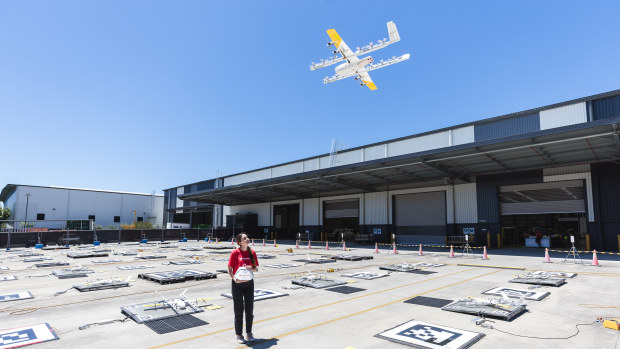
Wing and DoorDash have partnered to deliver items to Logan residents by drone.
Last year Wing’s drones delivered about 150,000 packages in Australia, and more than 80 per cent of those arrived at their destination within 15 minutes of the order being lodged.
Those orders come in through the Wing app, or via the DoorDash app. Once the order is placed, it is picked and packed by a worker into the drone which then flies autonomously to its destination at an altitude of about 60 metres. Delivery currently is free, but Wing plans to introduce a delivery fee this year.
On arrival at its destination, the drone drops to about 7 metres, where the parcel is lowered by a tether. The drone then returns to base at 110 kilometres an hour.
Wing’s payload can be up to 1 kilogram. As a result, Wing drones will not replace traditional forms of delivery and collection but can play a crucial complement, according to Mr Rossi.
“Drones work really well as part of the broader ecosystem. When we’re working alongside other delivery mechanisms it works really well. We do up to a kilo – anything above a kilo is not for a drone,” he said.
Sustainability
Wing drones are likely to carry small grocery items – perhaps something needed at the last minute for an evening meal – or fast food snacks. This year Wing hopes to expand its collection of nests to other suitable sites, closer to Brisbane, through Queensland and other states, keeping outside roughly a five-kilometre radius of CBDs.
Drone delivery is cheaper and faster than other modes for last-mile delivery – a big factor in its favour, with sustainability high on the agenda for corporates, Mr Rossi said.
“We’re using battery power. The amount of power we use to fly the drone that weighs just under five kilos is minuscule compared to other delivery methods. The green credentials of this platform are really important.”