
Terra Drone Corporation, a leading drone and Urban Air Mobility (UAM) technology company headquartered in Japan, is pleased to announce that it has entered into a capital and business alliance agreement and made a strategic investment in Amazing Drones LLC (hereinafter “Amazing Drones”), a company that develops and manufactures interceptor drones in Ukraine, through its subsidiary Terra Inspectioneering. In addition to expanding operations within Ukraine, Terra Drone will launch the interceptor drone “Terra A1” with Amazing Drones, promote the practical application of technical expertise cultivated in the country, and accelerate business development for global expansion.
In recent years, the global security environment has reached a major turning point. Particularly in the war in Ukraine, low-cost drones that can be deployed at scale have become a decisive factor on the battlefield, bringing about a significant transformation to conventional weapon systems characterized by high costs and small quantities. For example, there is an increasing number of cases where drones costing several hundred thousand yen neutralize weapons worth hundreds of millions of yen, fundamentally reshaping the economics of defense.” Under these circumstances, “countering low-cost threats with low-cost means” is becoming a new basic principle of defense.
Against this background, Terra Drone announced its full-scale entry into the defense equipment market on March 23, 2026 (*1), with the aim of contributing to the construction of a sustainable, next-generation defense foundation by utilizing the technology and operational expertise it has cultivated in the drone field worldwide.
Purpose of the Investment
Amazing Drones, the recipient of this investment, develops interceptor drones that can be deployed quickly and at low cost in the real combat conditions of Ukraine, where electronic warfare and communication jamming are commonplace, and possesses high technical capabilities and knowledge gained through actual combat. Through this investment, Terra Drone aims to incorporate these technologies and operational know-how and to establish solutions in the defense sector at an early stage.
Features of the New Interceptor Drone “Terra A1”
The new interceptor drone “Terra A1” is attracting attention as a new means of defense to replace conventional, expensive interceptor missiles, and features low cost, mass production capability, and quick response capability. It covers a range of 32 km at a maximum speed of 300 km/h, exceeding the typical 200 km/h speed of Shahed drones. By utilizing high stealth capabilities (low noise and low heat signature) through electric propulsion and achieving a flight time of 15 minutes, a single unit can complete the entire process from airspace surveillance to target detection and neutralization.
Terra Drone’s Future Outlook
Leveraging its mass-production technology and global expansion capabilities cultivated to date, Terra Drone will accelerate the development and supply of diverse unmanned assets, including interceptor drones, FPV drones, reconnaissance drones, and unmanned surface vessels (USVs).
Furthermore, in collaboration with partners in Japan, Europe, the United States, and other regions, the company will rmeet international defense demand and contribute to the improvement of security capabilities.
Terra Drone views the defense industry as an “industry that generates technological innovation and economic growth.” By building upon drone and AI technology, the company aims to construct a new social infrastructure by simultaneously achieving the strengthening of national security, the enhancement of industrial competitiveness, and the civilian application (spin-off) of technology.
Representatives’ Comments
Toru Tokushige, CEO of Terra Drone Corporation
“The exchange of UAVs seen in recent situations such as in the Middle East indicates that, in modern defense, securing defense drones that neutralize threats such as loitering munitions (suicide drones) is a top priority for the security of the international community.
Seeking an effective solution to this challenge, I have personally visited wartime Ukraine numerous times to engage in repeated dialogue with local engineers and relevant authorities. In that process, I gained confidence in the superior development capabilities of Amazing Drones, its ability to rapidly incorporate feedback from harsh combat environments into their aircraft, and we have built a strong relationship of trust.
Merging the knowledge Amazing Drones has cultivated in actual combat with the mass-production technology and quality control know-how possessed by Terra Drone is an extremely significant step toward building a next-generation defense foundation. Through this partnership, we will supply highly reliable solutions verified in combat environments to the world, contributing to the stability of the international community and strengthening deterrence.”
Maksym Klymenko, CEO of Amazing Drones LLC
“What began as a volunteer initiative by engineers and soldiers has now evolved into a manufacturing hub dedicated to defending our nation. Partnering with an international company like Terra Drone is an essential factor in elevating our operations from prototyping to reliable product supply. We look forward to Terra Drone’s global reach under Mr. Tokushige’s leadership and to advancing mass production together. I am confident that Terra Drone will be the pillar that brings our technology to the world. Through this partnership, we hope our innovations will help protect more lives.”
Terra Drone will continue to drive innovation in the defense sector and contribute to global stability and peace.
Related
Discover more from sUAS News
Subscribe to get the latest posts sent to your email.
Since its founding, Terra Drone has pursued its vision of transforming mobility in the sky, developing and operating drone technologies around the world while accumulating extensive expertise in drone applications across a wide range of industries.
In recent years, as the international situation has become increasingly unstable, the importance of deterrence through technology to protect the lives and property of citizens has grown more than ever before.
Leveraging the technological capabilities and practical operational expertise it has cultivated in the drone sector across global markets, Terra Drone will contribute to the development of a sustainable next-generation defense foundation by providing defense assets that are rapid to deploy, cost-efficient, and highly capable.
Background and Purpose
Since March 2026, the global geopolitical environment has been rapidly evolving, particularly in the Middle East, where tensions are escalating, as well as in the Indo-Pacific region. As the global security environment enters a major turning point, the very concept of defense is being redefined. Against the backdrop of major countries strengthening their defense capabilities, global defense-related spending in fiscal year 2024 exceeded a record high of USD 2.71 trillion (1), making the response to geopolitical risks one of the most critical shared challenges facing the international community.
In the recent Russia-Ukraine war, low-cost drones were deployed on an unprecedented scale as unmanned assets capable of reducing risks to human life, becoming one of the key applications in modern warfare. In response to these developments, countries around the world are now accelerating the development of new defense systems built on the premise of utilizing various unmanned assets, backed by expanding budgetary investment.
Specifically, the global military drone (UAV) market is estimated to be worth USD 15.8 billion in 2025 and is projected to reach USD 22.8 billion by 2030, representing a compound annual growth rate (CAGR) of 7.6% over the period (2).
Japan’s security environment is also becoming increasingly severe. With intensified military activities in surrounding regions and the emergence of new threats such as missiles and unmanned aerial vehicles, it is becoming increasingly difficult to maintain sufficient deterrence through conventional defense systems alone.
In Japan’s proposed fiscal 2026 budget, approximately USD 1.96 billion (3) has been allocated to strengthen defense capabilities involving unmanned assets, marking the largest budget of its kind to date and clearly demonstrating the national policy of positioning unmanned systems (4) at the core of defense.
In addition, under the “SHIELD” concept (5), a multilayered coastal defense framework targeted for establishment in fiscal 2027, Japan is considering a defense structure that combines unmanned assets and various sensors to provide wide-area, phased protection of coastal regions. Drones are expected to serve as one of the core unmanned assets within this framework.
Terra Drone views the defense market—where further expansion is expected across areas, applications, and operational domains—as a field with layered growth opportunities and significant medium- to long-term growth potential. By leveraging the operational expertise in drones that it has cultivated around the world, Terra Drone will work to accelerate the early implementation of solutions tailored to defense needs.
Future Initiatives
Going forward, Terra Drone believes that in the field of unmanned systems for defense, market demand will increasingly emerge and expand along the following three key axes. Terra Drone will position these areas as core strategic priorities.

1. Establishment of U.S. Subsidiary “Terra Defense” and Development of a Global Logistics Network
Terra Drone will establish “Terra Defense” in the United States to build a rapid and flexible supply structure capable of responding to international defense needs. In carrying out import/export operations and technology collaboration, the U.S. entity will oversee the import/export and logistics of defense assets.
The establishment of “Terra Defense” is planned to be completed within FY2026.
2. Phased Global Market Entry
Challenges such as rising geopolitical risks and the growing need to respond to unmanned assets (6) are increasingly becoming common across borders. Of global defense-related spending, which continues to remain at record-high levels, the unmanned systems sector in particular is regarded as a priority investment area, with annual growth projected to exceed 7.6% (7).
In addition to Japan, Terra Drone will promote the deployment of unmanned assets overseas through its “Terra Defense” including Ukraine, NATO member states, and Asian countries.
- Japan: A market where the adaptation of advanced civilian technologies to strengthen the domestic defense base is increasingly required, including under the government-led multilayered coastal defense concept known as SHIELD.
- Ukraine: A market in which operational knowledge from rapidly evolving modern warfare is updated on a daily basis, making agile product development based on real combat feedback and a highly reliable supply structure essential.
- NATO countries: Markets where, amid rising geopolitical tensions, demand is growing for technologies that support both efficient use of defense budgets and the rapid strengthening of defense capabilities.
- United States: An environment where compliance with strict Western defense standards is a prerequisite, and where interoperability and sustained cooperation within the international joint defense network centered on the Japan-U.S. alliance are emphasized.
- Other regions: Markets in which adoption by major allied countries serves as a benchmark of credibility, and where demand for versatile defense platforms is expected to emerge in phases in regions facing common security challenges, such as Asia and the Middle East.
3. Expansion of a Next-Generation Asset Portfolio Across Land, Air, and Sea
In the defense market, while multilayered air defense and coastal defense systems for protecting critical infrastructure remain central, demand is steadily expanding for unmanned assets across land, air, and sea. These include FPV drones (including fiber-optic models), interceptor drones (rocket-type, fixed-wing, and jet-engine-powered), unmanned surface vessels, reconnaissance drones, and OSA (Official Security Assistance) -related drones. Terra Drone will continue to advance product development to expand its lineup of drones and other systems tailored to these various applications.
- FPV drones: Primarily intended for responding to low-altitude threats such as reconnaissance drones. Certain models will incorporate fiber-optic systems to enable extremely stable operations even in jamming environments.
- Rocket-type interceptor drones: An interception solution with high cost efficiency and mass-production capability. These are designed to serve as an effective final line of defense against saturation attacks involving large numbers of small drones.
- Fixed-wing interceptor drones: Designed for wide-area patrol enabled by the characteristics of fixed-wing aircraft. If a target is detected but not intercepted, the drone can return to base and be reused, balancing operational efficiency with preventive defense capability.
- Jet-engine-powered interceptor drones: Core next-generation assets offering superior speed and range, designed for earlier detection and response at greater distances.
- Reconnaissance drones (ISR): Assets equipped with advanced imaging recognition and sensor technologies, specialized for real-time battlefield awareness and intelligence gathering.
- Unmanned surface vessels (USVs): Unmanned assets that support coastal and maritime security operations.
- Response to OSA (Official Security Assistance): Japanese-made aircraft provided through the “OSA” framework, which aims to enhance the security capabilities of like-minded countries. These platforms feature performance specialized for defense and security operations.
Representative’s Comment
Toru Tokushige, CEO of Terra Drone stated:
“The evolution of drone technology is irreversibly transforming the nature of security and defense. Our decision to enter this market marks an important first step in Terra Drone’s long-term business strategy. In line with the accelerating efforts to strengthen defense capabilities, we will focus on the deployment of products that address the needs of each country. By leveraging the real-world operational expertise in drones that we have cultivated around the world, we will actively promote digital transformation in defense that supports public safety and strengthens international deterrence.”
Future Outlook (Impact on Financial Results)
The impact of this matter on our financial results, as currently anticipated, has already been incorporated into the full-year consolidated earnings forecast for the fiscal year ending January 2027, announced on March 16, 2026. Should any matters requiring disclosure arise in the future due to the progress of this business, we will promptly make an announcement.
Editor’s Notes
(1) Aggregate estimate based on the Stockholm International Peace Research Institute (SIPRI) Military Expenditure Database and publicly disclosed defense budgets of major countries. https://www.sipri.org/databases/milex
(2) Based on data from the MarketsandMarkets research report, Military UAV Market – Global Forecast to 2030. https://www.marketsandmarkets.com/Market-Reports/military-drone-market-221577711.html?gad_source=1&gad_campaignid=272040196&gbraid=0AAAAADxY7SzVD22fsOVrWz5AQyFMwvLtz&gclid=Cj0KCQiA2bTNBhDjARIsAK89wlHf0R6tkhU4KUr5BG_YRYEaIFRnEe_HGFm8xq3hCC51eIShHtxTsB0aAsmoEALw_wcB
(3) Ministry of Defense, Defense of Japan and Budget (Overview of the FY2026 Budget Request). https://www.mod.go.jp/j/budget/yosan_gaiyo/index.html
(4) Unmanned systems refer to the overall frameworks, operational structures, and networks that utilize unmanned assets (see Note 6). Source: Ministry of Defense, Ground Staff Office, Ground Research & Development Command, publicly available materials.
https://www.mod.go.jp/gsdf/tercom/img/file2705.pdf
(5) Ministry of Defense, published materials on Development of the Multilayered Coastal Defense Framework (SHIELD). https://www.mod.go.jp/gsdf/tercom/img/file2705.pdf
(6) Unmanned assets refer to individual physical defense equipment and platforms, including drones (unmanned aerial vehicles), unmanned surface vessels (USVs), and unmanned underwater vehicles (UUVs). Source: Ministry of Defense, Ground Staff Office, Ground Research & Development Command, publicly available materials.
https://www.mod.go.jp/gsdf/tercom/img/file2705.pdf
(7) For further details, see the MarketsandMarkets research report, Military UAV Market – Global Forecast to 2030.
https://www.marketsandmarkets.com/Market-Reports/military-drone-market-221577711.html?gad_source=1&gad_campaignid=272040196&gbraid=0AAAAADxY7SzVD22fsOVrWz5AQyFMwvLtz&gclid=Cj0KCQiA2bTNBhDjARIsAK89wlHf0R6tkhU4KUr5BG_YRYEaIFRnEe_HGFm8xq3hCC51eIShHtxTsB0aAsmoEALw_wcB
Related
Discover more from sUAS News
Subscribe to get the latest posts sent to your email.

Terra Drone Corporation, a leading drone and Urban Air Mobility (UAM) technology company headquartered in Japan, is pleased to announce that its group company and a global leader in UAS Traffic Management (UTM) solutions, Unifly, has released a new position paper titled “Navigating the Urban Airspace: UTM as a Catalyst for Urban Air Mobility”. The position paper presents Unifly’s vision and roadmap for enabling safe and scalable next-generation air mobility through advanced UTM solutions.
Background of Unveil the Position Paper
With accelerating urbanization worldwide, there is an urgent demand for faster and more environmentally sustainable modes of transport. Against this backdrop, Urban Air Mobility (UAM)—leveraging technologies such as drones and eVTOL (electric Vertical Take-Off and Landing) aircraft—is rapidly emerging as a key solution for next-generation mobility.
Advancements in battery technology, lightweight materials, and automation are bringing eVTOL aircraft closer to large-scale commercial deployment. However, to realize safe and efficient operations, it is essential to address new challenges such as airspace safety and UTM infrastructure. As a leading UTM provider, Unifly has published this position paper to offer a comprehensive roadmap addressing these critical needs. The company clarifies the role of UTM as “digital infrastructure” that supports both the safety and scalability of airspace, and also provides recommendations for policy and regulatory framework development.
Overview of the Position Paper
The paper mainly covers the following topics and presents Unifly’s solutions and roadmap for the widespread deployment of next-generation air mobility.
Key topics include:
Transforming the Urban Sky
eVTOL aircraft will coexist with manned aircraft, helicopters, general aviation, and drones to offer a new transport option within the complex airspace over cities. With growing urbanization and evolving mobility demands, the foundation for aerial transportation is steadily taking shape.
Market Trends and Technology Advancements
Driven by technological breakthroughs and active investment from both the public and private sectors, UAM manufacturers are scaling up production at a rapid pace, even surpassing helicopter production volumes. New aircraft models—quieter, greener, and more cost-efficient—are increasingly entering the market, with urban ride-share-style air transport services becoming a tangible reality.
Key Barriers to Large-Scale Adoption
The widespread adoption of next-generation air mobility faces several major challenges, which pose significant barriers to seamless integration into existing transportation networks.
- Highly complex environment unique to urban areas
- Difficulty for existing air traffic control systems to manage a large volume of diverse vehicles
- Slow development of landing and take-off infrastructure (vertiports)
- Shortage of qualified pilots for UAM operations
- Absence of globally unified standards
- The delayed phased integration of air traffic management (ATM) and UTM in airspace shared by both manned and unmanned aircraft
Unifly’s Solution and Comprehensive Roadmap
To overcome these barriers, Unifly proposes a comprehensive roadmap to enhance UTM capabilities and enable safe and scalable deployment of next-generation air mobility. Key capabilities include:
- Strategic deconfliction of flight paths to prevent airspace congestion
- Vertiport slot allocation and management
- Optimal deployment and allocation of pilots and aircraft
- Real-time emergency response capabilities
- Preparation for the introduction of “Digital Flight Rules (DFR)” aimed at autonomous and remotely piloted operations
Through these initiatives, Unifly aims to establish a robust and reliable operational management framework that will support both safe and efficient operation of next-generation air mobility in urban areas.
Unifly’s Track Record and Future Prospect
For nearly a decade, Unifly has provided UTM solutions to aviation authorities and Air Navigation Service Providers (ANSPs) across the globe. The company remains at the forefront of next-generation airspace management systems centered on UTM and continues to actively contribute to their realization.
Through this position paper, Unifly aims to engage policymakers, industry leaders, and a wider audience with its strategic vision and to promote collaboration and dialogue toward building a safer and more efficient next-generation air mobility society.
The full the position paper can be downloaded here: https://www.unifly.aero/utm-uam-aam/
Related
Discover more from sUAS News
Subscribe to get the latest posts sent to your email.
The Reason Behind Producing “Terra Xross 1”
Indoor inspections often involve dangerous working environments in confined or elevated spaces, requiring significant preparation and raising costs for operations. While drones can improve safety and efficiency, existing indoor solutions face challenges like instability due to the lack of GPS and high initial costs, limiting adoption. To address these issues, Terra Drone developed “Terra Xross 1”, which integrates visual odometry sensors and Lidar for stable flight, making it easy to operate without advanced flight operation skills. Additionally, as an in-house developed product, “Terra Xross 1” enables it to be offered at an affordable price. Furthermore, “Terra Xross Cloud” has been launched simultaneously for 3D data management and rapid data sharing. These innovations enhance safety, efficiency, and cost-effectiveness, unlocking new possibilities for users of all experience levels.
Five Features of “Terra Xross 1”
“Terra Xross 1” is the Japan-Made indoor inspection drone designed for visual inspections, ensuring stable flight while being offered at an affordable cost.
- Stable Flight in Challenging Indoor Environments
“Terra Xross 1” integrates visual odometry sensors and Lidar for stable indoor flight. While conventional visual odometry sensors struggle in cramped, dark, and dusty conditions, Lidar estimates its position based on displacement, ensuring stability without relying solely on visuals. This enables seamless operation even in challenging environments.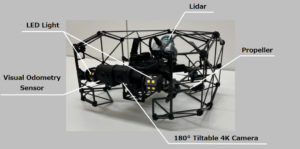 Product parts explanation
 - Affordable Pricing at Under $25,000 USD
By optimizing in-house development and production processes, Terra Drone has significantly reduced manufacturing costs. This allows “Terra Xross 1” to be offered at approximately one-third the cost of existing indoor drones. - Extended Flight Time with Tethering Module
Conventional indoor drones have faced limitations due to short flight time. “Terra Xross 1” addressed this by supporting both battery-powered operation and tethered power module, enabling continuous flight with a constant power supply. This eliminates the risk of crashes from power depletion and allows for uninterrupted, efficient inspections without the need for battery replacements.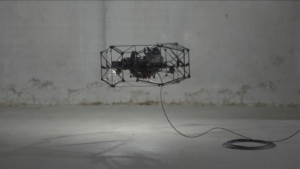 Flight demonstration using the tethered power module
 - Advanced Imaging with 180° tiltable 4K Camera and LED Light
Equipped with a 4K camera that can tilt 180° vertically, “Terra Xross 1” captures high-quality images and videos even in challenging conditions. The powerful LED lighting ensures clear visibility in low-light environments. - Streamlined Data Management with “Terra Xross Cloud”
By uploading the acquired inspection data to “Terra Xross Cloud”, users can easily visualize the captured data in a 3D space and seamlessly manage and share both point cloud data and recorded video footage. This helps rapid information sharing among team members and facilitates workflow efficiency.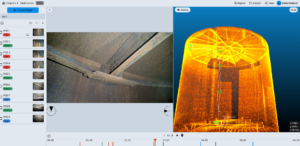 Captured image data and acquired point cloud data available for viewing on “Terra Xross Cloud”
Transforming Indoor Inspection with “Terra Xross 1”
“Terra Xross 1” is designed for versatile applications across various industries and operations:
- Infrastructure Inspection: Inspection of high and confined spaces in oil and gas plants.
- Mining Mapping: 3D mapping survey for excavation planning in underground mines.
- Disaster Assessment: Investigation of collapsed buildings in disaster-affected areas.
- Security Monitoring: Safety checks and surveillance inside government and public buildings.
By offering “Terra Xross 1”, a cost-effective solution, Terra Drone aims to make advanced drone technology more accessible to the indoor inspection sector. Since this drone enables stable flight without requiring specialized piloting skills during operations, it is expected to be utilized in a wide range of applications. Terra Drone continues to be committed to driving safety and efficiency in indoor inspections worldwide with its Japan-Made drone, “Terra Xross 1”.
About Development Support
The development of the Terra Xross 1 was supported by the Nippon Foundation-DeepStar Collaboration Program for decarbonization in the offshore oil and gas sector (2).
Editor’s Note
1 This is the first product designed for inspection launched both domestically and internationally.
2 The program, established in December 2021 under a Memorandum of Understanding between the Nippon Foundation and DeepStar, promotes technological development to advance decarbonization in the offshore oil and gas industries.
About The Product
More Information: https://terraxross.terra-drone.net/en
Inquiry Form: https://pdt.terra-drone.net/l/1016432/2025-01-28/48z6r
Related
Discover more from sUAS News
Subscribe to get the latest posts sent to your email.