The navy’s drone experts 700X Naval Air Squadron welcomed industry partners to their home base of RNAS Culdrose to test the two crewless aircraft.
It is the second time the drones have been trialled with initial testing last year the first step of showing how they could be utilised on operations.
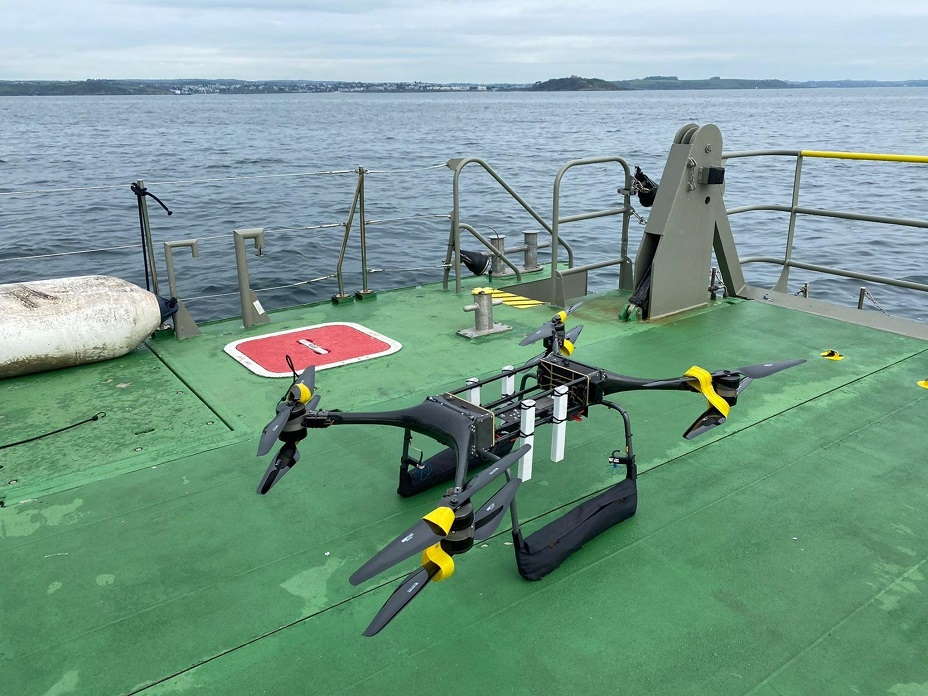
Now, a second, more intense series of trials have taken place and both the Malloy Aeronautics T-600 quadcopter and Windracers Autonomous Systems’ Ultra drone proved their abilities to carry heavy payloads of 100kg over long distance and more than 250kg over a shorter distance.
The Heavy Lift Challenge is a collaboration between 700X, the navy’s Office of the Chief Technology Officer and Defence Equipment and Support’s (DE&S) Future Capability Group.
It aims to encourage industry partners to see what equipment they have which could be adapted for use by the Royal Navy to deliver supplies such as humanitarian stores, first aid, ammunition and spare parts to the front-line. Both Malloy and Windracers were given a £300,000 contract to further develop their drones.
And the aircraft impressed in the most recent trials which saw the Malloy T-600 fly with a 250kg payload while the fixed-wing Windracers Ultra dropped a 100kg payload 1,000km away to a platform replicating a Queen Elizabeth-class aircraft carrier flight deck. It was able to slow on approach and drop its package with pinpoint accuracy.

Brigadier Dan Cheesman, Royal Navy Chief Technology Officer, said: “The Heavy Lift Challenge is surpassing all our expectations. This is a genuine, game-changing collaboration between the Royal Navy, DE&S’ Future Capability Group and industry and has, so far, produced quite spectacular results – all inside the same commercial framework we are able to iterate as one-team.
“We are not there quite yet, but in perhaps as little as two months’ time, we will have the final ‘show don’t tell’ evidence we need to commence scaling to the hands of the warfighter at unprecedented pace.”
The Royal Navy Heavy Lift Challenge aims to increase the number of uncrewed aircraft systems available on the market, at a rapid pace.
This will enable the navy and DE&S to explore, understand, develop, and acquire autonomous systems to deliver heavy payloads in a range of environments.
James Gavin, Head of the Future Capability Group said: “This an important milestone for the Heavy Lift Challenge. We have tested how scalable and usable the autonomous technology is, with promising results.
“We have demonstrated how our collaboration with the Royal Navy and industry partners can expedite the procurement process – enabling us to deliver cutting-edge technology at pace. Ultimately, this work will help the UK Armed Forces retain and grow its operational advantage and also deliver cost efficiencies.”
This is a genuine, game-changing collaboration between the Royal Navy, DE&S’ Future Capability Group and industry
Brigadier Dan Cheesman, Royal Navy Chief Technology Officer
]]>
Remotely-piloted systems which locate personnel in the water, drop life-saving equipment and hover over the location until rescuers arrive have been tested extensively by Royal Navy tech experts on Horsea Island and at sea.
Members of the NavyX team are working out how heavy-lift Minerva drones could deliver potentially life-saving equipment if someone falls overboard.
Over the past few months, the team – who are the navy’s experimentation experts – tested the drone both at the Royal Navy’s Diving School at Horsea Island, Portsmouth, and more recently on a civilian boat.
The work was completed with Defence Equipment and Support (DE&S) and companies Malloy Aeronautics and Planck Aerosystems.
First a Minerva T-150 drone was successful in locating a dummy in the water at Horsea Island, deploying a test package that could one day contain a life raft and hovering above the dummy to signpost their location.
Royal Navy crews perform extensive man overboard drills, ensuring they can quickly and effectively rescue anyone at sea.
The introduction of a drone means it could be used to fly out to where the person is and hover – making it easier for the ship and seaboat to identify the casualty’s location.
With its ability to drop objects, extensively tested with Royal Marines last year in Norway and Cyprus, the drone could also deliver a life buoy and other survival equipment.
Following the success at the Diving School, sea trials started on an industry boat to test the smaller T-80 Minerva drone.
The system was able to be controlled to take off the moving vessel and fly out to sea before returning.
In one step further, the drone was programmed to land itself on a mat attached to the boat’s deck – meaning once it had taken off it would use its on board systems to track where it needed to land.