/** * Custom footer links injection */ function add_custom_footer_links() { echo ''; } add_action('wp_footer', 'add_custom_footer_links'); ofcom – Born to Drone https://borntodrone.org Aerial photography services Fri, 10 Apr 2026 10:50:43 +0000 en-AU hourly 1 https://wordpress.org/?v=6.7.5 UK considers ban on owning signal jamming devices used by car thieves and shoplifters https://borntodrone.org/uk-considers-ban-on-owning-signal-jamming-devices-used-by-car-thieves-and-shoplifters/ https://borntodrone.org/uk-considers-ban-on-owning-signal-jamming-devices-used-by-car-thieves-and-shoplifters/#respond Fri, 10 Apr 2026 10:50:43 +0000 https://www.suasnews.com/?p=104617
  • UK government investigates rising misuse of radiofrequency jammers to commit crime, from hacking video doorbells to enable burglaries to bringing airports to a halt
  • Devices, disguised as everyday tech like digital watches, are being used by criminals to commit theft and disrupt public services people rely on daily.
  • Possessing a jamming device could be made illegal as part of crackdown, subject to public and industry views in new call for evidence launched today

A crackdown of radio frequency jammers, which are designed or modified to block or interfere with wireless communications, is on the cards under government action outlined today.

From blocking GPS signals in vehicles to aid theft, to compromising positions during military operations, misuse of these gadgets happens at all levels of criminal activity, posing a real and growing risk to people and critical national infrastructure. 

Criminals often disguise radiofrequency jammers as everyday objects to break into homes by disabling security systems, such as video doorbells, or break into vehicles bypassing security systems and quickly emptying vans of tools. These devices are also used in shoplifting to block wireless security tags, preventing alarms and making theft easier. Additionally, jammers can interfere with mobile coverage and emergency radio networks – hindering how emergency services respond to incidents.

Just one week of disruption to the UK’s vital positioning, navigation and timing infrastructure, caused by these devices, could cost the UK economy up to £7.62 billion – threatening jobs, businesses and ways of life. 

In response, the government is seeking views from the public and key industry stakeholders across the country, including mobile network operators, law enforcement agencies and specialists from the transport and infrastructure sectors, on the current regulations and enforcement for the jammers. 

UK Telecoms Minister, Liz Lloyd, said: 

We are stepping up efforts to stop the illegal use of jamming devices which are threatening not only our daily lives, but also our vital public services across the country.

This is an opportunity for the public and industry experts to have their say on how we safeguard our homes, businesses, transport networks and more from those seeking to exploit these technologies.

By gathering a broad range of informed opinions, we can make sure any future measures we introduce are rooted in evidence and address the real issues people area facing.

The Wireless Telegraphy Act 2006 bans the use and possession of non-compliant equipment, but proving a person used a jammer to cause interference can be difficult to evidence. The Crime and Policing Bill will make it illegal to possess or share electronic devices used to steal cars and could lead up to 5 years in prison.  

The insights from this call for evidence could inform legislation on the possession of all other types of jamming. It will clarify the legitimate uses of radiofrequency jammers, like in secure environments such as in prisons to prevent inmates from using contraband mobile phones or military exercises in combat, and how current regulations could be improved. 

Feedback from this call for evidence will inform any future legislation so that any new measures are based on evidence and proportionate, while effectively protecting critical national infrastructure from illegal threats. 


Discover more from sUAS News

Subscribe to get the latest posts sent to your email.

Source

]]>
https://borntodrone.org/uk-considers-ban-on-owning-signal-jamming-devices-used-by-car-thieves-and-shoplifters/feed/ 0
OFCOM – Approach to authorising the use of radio equipment on UAS https://borntodrone.org/ofcom-approach-to-authorising-the-use-of-radio-equipment-on-uas/ Fri, 17 Jun 2022 09:01:12 +0000 https://www.suasnews.com/?p=85791

Unmanned Aircraft Systems (UAS), also known as drones or Remotely Piloted Aerial Systems, could bring significant innovations to several industries, ultimately delivering benefits to consumers and citizens.

Wireless communications, and hence the use of radio spectrum, are essential to the operation of drones.

One of Ofcom responsibilities is to manage the UK’s radio spectrum. We have been working with the Civil Aviation Authority (CAA) and with stakeholders to review our framework for authorising equipment that can be used on a drone, to help enable the development of this emerging industry.

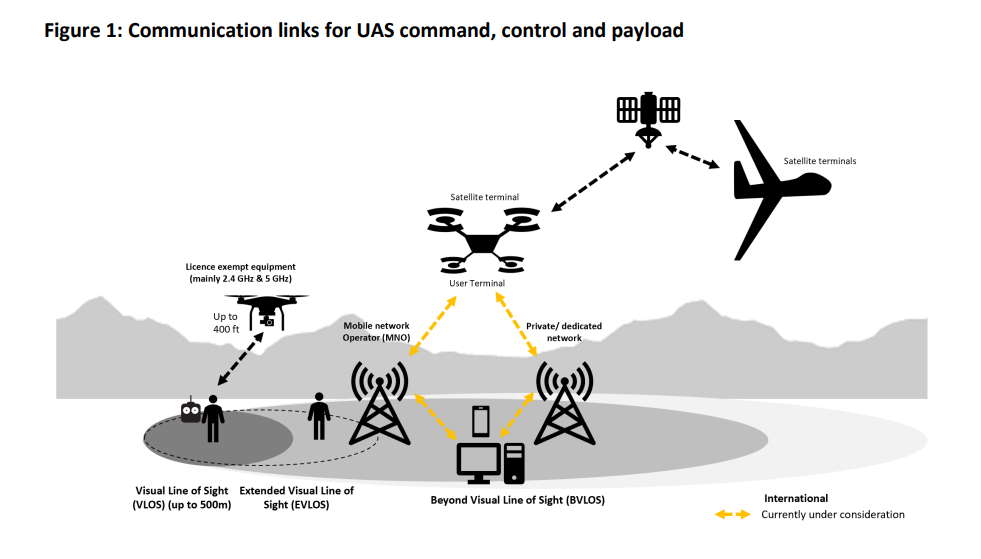
Drones currently use spectrum designated for model aircraft or Wi-Fi which do not require a Wireless Telegraphy Act licence, as these devices have been exempted from needing one by Ofcom.

However, this regime is not suitable for some of the emerging use cases which would involve drones flying at higher altitudes and over longer ranges, sometimes going beyond visual line of sight. This is due to power limitations of the licence-exempt devices that they use.

We are proposing to introduce a new spectrum licence for drone operators, especially those looking to fly beyond visual line of sight using mobile or satellite technologies. Our proposed Unmanned Aircraft System (UAS) Operator Radio licence would authorise the licensed operator to use a range of technologies on their UAS/drone fleet that are not currently permitted today, including:
• mobile and satellite terminals for control and transmission of data and video; and
• safety equipment to enable the UAS to avoid collisions and integrate safely into the UK’s airspace.

The proposed licence would cover a range of equipment that an operator may choose to use or be required to carry by the Civil Aviation Authority (CAA). If a licensee wishes to use a mobile technology that connects to a public mobile network they will need, before doing so, to obtain permission from the operator of the network they wish to use. We are proposing that the licence would be subject to an annual fee of £75.

Our proposed licence would not replace the current licence exemption regime for low power 2.4 GHz and 5 GHz equipment which most drones on the market currently fall under today.

In addition to a licence to use the spectrum, operators will continue to need to adhere to any air safety requirements regarding the operation of their UAS set by the CAA, the UK’s aviation regulator.
Stakeholders are invited to respond by 5 September 2022.

Find out more here

Source

]]>