Commercial UAV Expo returns to Las Vegas September 1–3, bringing more than 3,700 commercial drone professionals and 240-plus exhibitors to Caesars Forum. This year, the timing may be as important as the technology on display.
The event arrives during a period of significant change for the U.S. commercial drone industry. The FAA is developing a new framework for routine beyond visual line of sight (BVLOS) operations. At the same time, the FCC Covered List, NDAA requirements, tariffs, and supply chain policies are changing the environment for manufacturers and operators.
For the DRONELIFE team, that makes this year’s Commercial UAV Expo an important opportunity to hear directly from regulators, operators, and manufacturers. DRONELIFE Editor Miriam McNabb will also take the stage to discuss gaps and opportunities in the U.S. commercial drone market.
Here are a few events we’re putting on our must-see list, along with some friends and partners to visit on the show floor.
Regulation Takes Center Stage
Regulation will be a major theme throughout the three-day event. The program includes discussions of Part 108 and Part 146, the FCC Covered List, NDAA compliance, and BVLOS operations.
Among the full conference program, these three sessions are particularly high on our list.
Preparing for the Next Era of Advanced Aviation Technologies
Wednesday, September 2, 3:00–3:30 p.m. PDT | Forum Theater
FAA Executive Director of the Office of Advanced Aviation Technologies Jessica Jones and Associate Administrator for Security and Hazardous Materials Safety Ben Supko will discuss how the National Airspace System is adapting to support drones and other advanced aviation technologies.
Two Skies, One Conversation: Comparing FAA and EASA Approaches to BVLOS Drone Operations
Thursday, September 3, 9:00–10:00 a.m. PDT | Room 401–404
The closing keynote brings U.S. and European regulators together to compare approaches to BVLOS operations. FAA Flight Standards Service Acting Deputy Director, Office of Safety Standards Robert Reckert will join EASA Certification Directorate Head of Innovative Air Mobility Daan Dousi. Avtrain CEO and JARUS ISB Vice-Chair Julie Garland will moderate.
And, if you can make it, we’d love to see you in the audience here:
Seizing the Moment: Finding Opportunity in the Commercial Drone Market’s Gaps
Thursday, September 3, 11:30 a.m.–12:00 p.m. PDT | Forum Theater
DRONELIFE Editor Miriam McNabb will discuss current gaps and opportunities in the U.S. commercial drone market.
See the full Commercial UAV Expo 2026 schedule.
Find Our Friends and Partners on the Show Floor
Commercial UAV Expo is also a chance to see new technology, meet the teams behind it, and catch up with companies from across the industry.
If you’re headed to Las Vegas, make time to visit some of DRONELIFE’s friends and partners:
- AirData UAV, Booth 914. Drone fleet management and flight data solutions.
- Appelix, on the floor – US Manufactured spray drones. Appelix is looking for US battery manufacturers and partners!
- BRINC, Booth 845. Public safety drone hardware, software, and services.
- DeTect, Inc., Booth 1925. Radar and airspace awareness technologies.
- Drone Nerds, Booth 831. Commercial drone platforms, payloads, and enterprise solutions.
- Drone Rescue Systems, Booth 908 Automatic ultra-light parachute safety systems for commercial drones.
- DRONERESPONDERS, Training and networking for the public safety drone community. See their Program Management Course.
- Federal Aviation Administration, Booth 2135.
- Flyability, Booth 1837. Indoor and confined-space inspection drones.
- HP, Booth 431. Additive manufacturing technology and solutions for drone manufacturing. HP’s Doug Nicklin will participate in the panel discussion, “The Future of Flight: How AI and Advanced Manufacturing are Transforming Drone Innovation,” on September 3 from 1:30-2:30 PM in Room 409-412.
- Inspired Flight Technologies, Booth 447. U.S.-manufactured commercial and government UAS.
- Korean Pavilion, Booth 409, featuring Korea’s Ministry of Land, Infrastructure and Transport and Korea Institute of Aviation Safety Technology (KIAST).
- Micantis, on the floor – battery quality testing and tracking software. Talk to them about securing your battery supply chain!
- RIIS, Booth 855. Software and engineering solutions for drones and autonomous systems.
- SimActive, Booth 1024. Correlator3D photogrammetry software for drone and aerial imagery.
- Warren Community College / WarrenUAS, Booth 1807. UAS education and hands-on training.
See You in Las Vegas
Commercial UAV Expo has always offered a chance to see new aircraft, sensors, software, and services in one place. This year, attendees will also be able to hear directly from regulators as the rules and market conditions surrounding commercial drone operations continue to change.
For DRONELIFE, it is also an opportunity to reconnect with the people and companies helping move the industry forward. If you’ll be at the show, we hope you’ll join us for the sessions, stop by our friends’ booths, and say hello.
Commercial UAV Expo 2026 takes place September 1–3 at Caesars Forum in Las Vegas.

Miriam McNabb is the Editor-in-Chief of DRONELIFE and CEO of JobForDrones, a professional drone services marketplace, and a fascinated observer of the emerging drone industry and the regulatory environment for drones. Miriam has penned over 3,000 articles focused on the commercial drone space and is an international speaker and recognized figure in the industry. Miriam has a degree from the University of Chicago and over 20 years of experience in high tech sales and marketing for new technologies.
For drone industry consulting or writing, Email Miriam.
TWITTER:@spaldingbarker
Subscribe to DroneLife here.
Cats may seem an unlikely source of inspiration for drone landing gear. But retractable claws helped researchers at Canada’s Université de Sherbrooke address a difficult problem: landing a drone on steep, slippery ice.

The result is the Ice Dart, a multirotor designed to land and remain perched on steep ice surfaces.
Researchers Isaac Tunney, John Bass, and Alexis Lussier Desbiens developed the system at Université de Sherbrooke. Their work was published in IEEE Transactions on Field Robotics as “The Ice Dart: Landing on Steep Ice Using Spiny Feet, Dissipative Landing Gear and Reverse Thrust.”
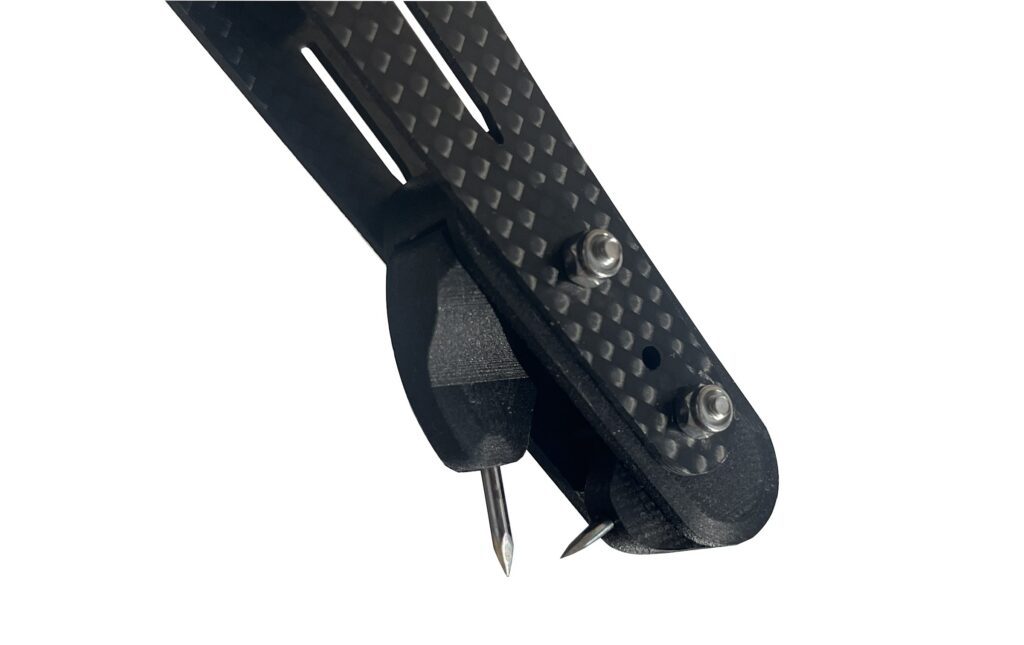
The team tested Ice Dart on natural icebergs and glaciers in Iceland. Across 24 field landings, the aircraft handled slopes of up to 58 degrees and winds exceeding 30 km/h, according to information provided by the researchers. Controlled testing demonstrated landings on ice slopes of up to 60 degrees and touchdown speeds of up to 3 meters per second.
Claws, Shock Absorption and Reverse Thrust
Landing on steep ice requires the aircraft to absorb the impact while gaining enough grip to avoid sliding or tipping.
Ice Dart combines three approaches.
Retractable spines inspired by a cat’s claws deploy during landing to grip the ice. Friction-based landing gear dissipates energy during impact. The aircraft also uses reverse thrust at touchdown to help stabilize the landing.
Together, these technologies expand the conditions in which a multirotor can land.
Ice Dart builds on earlier research by the same Université de Sherbrooke team. Tunney, Bass, and Lussier Desbiens have studied methods for landing multirotors on steep surfaces and high-speed moving vehicles. Their previous work also used friction shock absorbers and reverse thrust to increase the landing envelope.
The Ice Dart takes that research into a particularly difficult natural environment.
Landing Instead of Hovering
The ability to land on ice could also extend the usefulness of small drones for sensing missions.
A multirotor must continuously power its motors while hovering. Landing allows it to remain in place without using energy to stay airborne. This could allow a drone to serve as a temporary sensing station on an iceberg or other natural surface.
Potential applications identified by the researchers include iceberg tracking, maritime safety, environmental research, and Arctic surveillance and domain awareness.
The Iceland trials demonstrate the system outside controlled laboratory conditions, including on irregular natural ice and in wind.

More broadly, Ice Dart is part of the Université de Sherbrooke team’s effort to expand where multirotor drones can land. The researchers have previously demonstrated landings on moving boats, vehicles traveling at high speeds, and steep rooftops.
With Ice Dart, they have added glaciers and icebergs to that list.
Research: The Ice Dart: Landing on Steep Ice Using Spiny Feet, Dissipative Landing Gear and Reverse Thrust, Isaac Tunney, John Bass and Alexis Lussier Desbiens, IEEE Transactions on Field Robotics.
Read more:
Miriam McNabb is the Editor-in-Chief of DRONELIFE and CEO of JobForDrones, a professional drone services marketplace, and a fascinated observer of the emerging drone industry and the regulatory environment for drones. Miriam has penned over 3,000 articles focused on the commercial drone space and is an international speaker and recognized figure in the industry. Miriam has a degree from the University of Chicago and over 20 years of experience in high tech sales and marketing for new technologies.
For drone industry consulting or writing, Email Miriam.
TWITTER:@spaldingbarker
Subscribe to DroneLife here.
Saildrone announced a major European expansion on August 18, 2026, from its new EU headquarters in Copenhagen. The expansion includes three build contracts across Northern Europe. Van Der Valk Shipyard in the Netherlands will build the first European-produced 52-meter (171-foot) Saildrone Spectre. Umoe Mandal in Norway will produce the next-generation Surveyor and Southern Spars in Poland will build its wings. The investments target Saildrone unmanned surface vehicles (USVs) for European customers.
“We are proud to announce not one, but three large construction projects. The first European-built 52-meter Saildrone Spectre will be built at Van Der Valk Shipyard in the Netherlands; the next generation of the Saildrone Surveyor will be produced at Umoe Mandal in Norway; and Southern Spars will produce Surveyor wings in Poland,” said Richard Jenkins, Saildrone founder and CEO. “Our EU Headquarters in Copenhagen will facilitate business development, maintenance operations, and piloting activities throughout our European operations.”
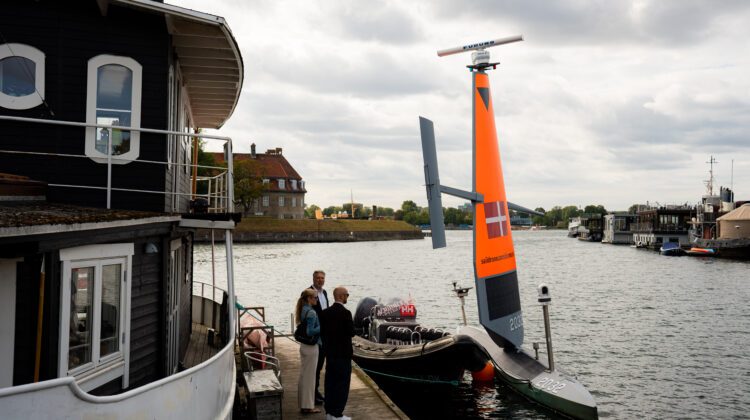
Copenhagen EU headquarters
The Copenhagen office sits at Quintus Bastion in Holmen, a 17th-century former Royal Danish Navy headquarters. New roles cover Mission Management, Vehicle Assembly and Service, Technical Operations and the Pilot Team. Defence Industry Attaché, His Royal Highness Brigadier General Prince Joachim of Denmark officiated the ribbon-cutting ceremony on August 17.
“It is fantastic to see Saildrone’s European headquarters located here in this historic naval site in Central Copenhagen,” said Prince Joachim. “Saildrone brings some of the latest maritime sensing technology to Denmark, which will certainly help protect our shared European waters against the many real threats we face today.”
Sovereign capability for European partners
Saildrone established its European subsidiary in April 2025. A $60 million funding round led by EIFO, the Export and Investment Fund of Denmark, backed the subsidiary. Four Saildrone Voyager USVs completed a six-month Danish Ministry of Defence deployment with 92% fleet uptime. The vehicles detected more than 170,000 unique contacts in harsh weather. Saildrone operates a fleet of more than 70 USVs across four classes. The classes include the 7-meter (23-foot) Explorer, 10-meter (33-foot) Voyager, 20-meter (66-foot) Surveyor and 52-meter Spectre.
“Saildrone USVs have helped governments around the world to improve maritime domain awareness, counter drug trafficking, migrant crossings, and illegal fishing, and protect critical marine infrastructure,” said Robert Kleist, managing director of Saildrone Europe. “We are pleased to bring that proven capability to our European partners facing many of the same challenges. Bringing Saildrone manufacturing and operations to Europe creates an enduring sovereign capability for our European customers.”
Saildrone participates in DALO Industry Days in Herning on August 19-20, 2026. More information is available at Saildrone.
Read More

Ian McNabb is a journalist focusing on drone technology and lifestyle content at Dronelife. He is based between Boston and NH and, when not writing, enjoys hiking and Boston area sports.
President Donald Trump has imposed new tariffs on imported drones and certain drone components following a Commerce Department national security investigation.
The August 13 proclamation uses Section 232 of the Trade Expansion Act of 1962 to establish additional tariffs ranging from 25% to 100%. Most take effect September 3, 2026. Certain component tariffs take effect February 9, 2027.
Commerce opened its Section 232 investigation on July 1, 2025. The investigation examined U.S. reliance on foreign sources of unmanned aircraft systems (UAS) and their components.
The proclamation states:
“UAS and UAS components are being imported into the United States in such quantities and under such circumstances as to threaten to impair the national security of the United States.”
The White House cited the importance of drones for military operations as well as law enforcement, mapping, agriculture, disaster relief, search and rescue and other applications.
Tariffs Range From 25% to 100%
The highest new tariff applies to drones weighing more than 25 kilograms and drones equipped with thermal imaging. Covered products face an additional 100% Section 232 tariff.
That means size is not the only factor. Imported thermal drones weighing 25 kilograms or less also fall under the 100% category. Annex I includes thermal-equipped aircraft across weight classes from 250 grams or less through 25 kilograms.
Smaller drones without thermal imaging face a 25% Section 232 tariff. Annex II covers UAS weighing up to 25 kilograms, including remotely controlled and non-remotely-controlled aircraft.
The 100% category also includes docking stations and certain covered components.
These are additional Section 232 duties, not necessarily the total tariff burden. Other applicable duties and charges continue to apply.
U.S. Manufacturers Also Depend on Foreign Components
The proclamation acknowledges that foreign supply-chain dependence extends to drones manufactured domestically: “Most commercial and industrial UAS, even those produced in the United States, incorporate critical parts and components produced overseas.”
The White House identifies motors, electronic speed controllers, lithium-ion batteries and docking stations among areas of foreign dependence.
The tariff annexes do not, however, impose a tariff on every imported motor, battery or electronic speed controller. Annex I identifies specific classifications, including static converters, certain electrical control equipment and covered aircraft parts.
Annex III covers specified aircraft-parts classifications, including propellers and rotors, undercarriages and other aircraft parts imported for UAS use. The 25% Section 232 tariff on those products takes effect February 9, 2027.
Incentives for U.S. Manufacturing
The proclamation also directs Commerce to establish an onshoring program for companies investing in U.S. production of drones and components.
Companies can submit plans to build, refurbish or expand U.S. manufacturing facilities. Approved companies may receive tariff benefits for covered imports while those investments are underway.
The proclamation says the measures are intended to: “promote investment, employment, manufacturing, and innovation in the United States for UAS and UAS components and accessories.”
Approved plans will be monitored by Commerce, which can rescind benefits if companies substantially fail to meet their commitments.
The program also connects with the FCC Covered List process. The proclamation directs Commerce to consider certain onshoring plans approved by the Department of War or Department of Homeland Security and provides for coordination among the agencies.
Lower Rates for Qualifying Allied Supply Chains
The proclamation provides different tariff treatment for qualifying products from several U.S. allies and trading partners.
Products from Japan, South Korea, Taiwan, Switzerland, Liechtenstein and European Union countries can qualify for a rate no higher than 15%. Qualifying UK products receive a rate no higher than 10%.
Eligibility goes beyond where the finished drone is produced. The proclamation requires that “substantially all the critical components and technology” come from the United States or designated countries.
Commerce will establish the process for determining which products qualify.
Part of a Broader Drone Policy
The tariff action follows the June 2025 Unleashing American Drone Dominance executive order, which called for measures to expand domestic drone manufacturing and strengthen U.S. supply chains. Commerce opened its Section 232 investigation the following month.
Most of the new tariffs take effect September 3. The 25% tariffs on additional covered components follow in February 2027.
Commerce can also add UAS components to the tariff program if it determines that their imports contribute to the national security concerns identified in the proclamation or undermine the action. Commerce must provide the President with an update within 120 days.
The measures combine import tariffs, preferential treatment for qualifying allied supply chains and incentives for companies to expand U.S. drone and component manufacturing.
Read more:
Miriam McNabb is the Editor-in-Chief of DRONELIFE and CEO of JobForDrones, a professional drone services marketplace, and a fascinated observer of the emerging drone industry and the regulatory environment for drones. Miriam has penned over 3,000 articles focused on the commercial drone space and is an international speaker and recognized figure in the industry. Miriam has a degree from the University of Chicago and over 20 years of experience in high tech sales and marketing for new technologies.
For drone industry consulting or writing, Email Miriam.
TWITTER:@spaldingbarker
Subscribe to DroneLife here.
FlybyOps has launched a new enterprise drone operations platform designed for large-scale Beyond Visual Line of Sight (BVLOS) and autonomous drone programs.
The Finland-based company says the platform addresses a growing challenge for commercial drone operators. As fleets expand, operators must manage more flights, locations, aircraft and personnel. At the same time, they must maintain regulatory compliance and operational control.
FlybyOps provides a central platform for managing those elements. It connects flight operations with aircraft, personnel, procedures, risk management and compliance requirements.
The platform focuses heavily on compliance and traceability. Operators can use it to manage flight approvals, personnel qualifications, aircraft, equipment and operational risk. It also supports incident reporting, corrective actions, audits, documentation and flight histories.
The goal is to create an auditable record of operations as drone programs move beyond individually managed missions. This becomes more important as organizations conduct more frequent and increasingly autonomous flights.
Managing the Shift to Larger BVLOS Programs
FlybyOps says operators are already using the platform globally to support BVLOS flight operations.
The company developed the system around the needs of organizations preparing to scale autonomous and BVLOS operations. Key features include role-based access, configurable workflows, multi-project management and structured compliance processes.
Stephen Sutton, CEO of Flyby Guys, said the operational challenge changes as drone programs expand.
“The challenge changes completely when you move from operating a few drones to running hundreds or potentially thousands of BVLOS flights. It becomes much less about managing an individual flight and much more about managing the entire operational system behind it.
FlybyOps is being built for that transition. We want to provide enterprise operators with the compliance, operational control and visibility they need to safely scale autonomous drone operations.”
FlybyOps sees potential applications in logistics, infrastructure and other industries where BVLOS could support routine operations. The platform aims to provide a common operational structure across those programs.
Preparing for Higher-Volume Autonomous Operations
The launch comes as the drone industry prepares for a shift toward larger fleets and more autonomous operations.
FlybyOps points to the continued development of regulatory frameworks, U-space infrastructure and autonomous aircraft technology. These changes could increase both the number and complexity of flights managed within a single operating environment.
That growth also changes the role of drone management software. Systems designed primarily to organize individual missions may need to support broader operational and compliance requirements as fleets scale.
FlybyOps positions its platform as part of that supporting infrastructure. It aims to help organizations establish repeatable processes while maintaining records across flights, aircraft, personnel and compliance activities.
The company says this approach can help operators build the processes needed today while preparing for much larger autonomous operations in the future.
Read more:
Miriam McNabb is the Editor-in-Chief of DRONELIFE and CEO of JobForDrones, a professional drone services marketplace, and a fascinated observer of the emerging drone industry and the regulatory environment for drones. Miriam has penned over 3,000 articles focused on the commercial drone space and is an international speaker and recognized figure in the industry. Miriam has a degree from the University of Chicago and over 20 years of experience in high tech sales and marketing for new technologies.
For drone industry consulting or writing, Email Miriam.
TWITTER:@spaldingbarker
Subscribe to DroneLife here.
When Reuters reported that India’s Larsen & Toubro (L&T) expects the division that includes its drone business to triple revenue over the next five years, the announcement sounded like another optimistic corporate forecast. Viewed in a broader context, however, it suggests something more significant.
Around the world, drones are increasingly becoming the business of large industrial manufacturers rather than startups. Governments are investing in domestic production, resilient supply chains, and long-term manufacturing capacity. Companies are talking less about prototypes and more about factories.
L&T’s outlook is one more indication that the drone industry is entering a new phase, where the ability to manufacture at scale may become as important as developing the next breakthrough aircraft.
More Than a Drone Company
Founded in 1938, Larsen & Toubro is India’s largest engineering and technology conglomerate. Its businesses span infrastructure, energy, heavy engineering, shipbuilding, aerospace, defense, electronics, and information technology. Rather than resembling a traditional drone manufacturer, L&T occupies a position closer to a diversified industrial and defense contractor.
That context matters.
According to Reuters, the company’s Precision Engineering & Systems division, which houses its drone business, currently accounts for only a small portion of overall revenue. The division also includes military electronics, aerospace manufacturing, naval systems, radar, and other advanced technologies.
In other words, drones are not a standalone venture. They are becoming another product line within a broader portfolio of advanced manufacturing. That mirrors a larger trend across the global defense and aerospace industries.
Manufacturing Is Becoming a Competitive Advantage
For much of the past decade, success in commercial drones depended largely on innovation. Companies competed on aircraft design, flight performance, autonomy, and new applications.
Those factors remain important, but customer expectations have changed.
Enterprise and government buyers increasingly ask different questions:
- Can the manufacturer deliver thousands of aircraft?
- Can it secure critical components?
- Can it maintain consistent quality across production?
- Can it support fleets for years after delivery?
- Can it meet evolving security and regulatory requirements?
These are manufacturing questions as much as engineering ones.
The shift is particularly evident in defense markets, where procurement increasingly emphasizes trusted supply chains, domestic production, and long-term sustainment alongside aircraft performance.
A Global Trend
L&T is far from the only example.
In France, policymakers and manufacturers are exploring how the country’s established automotive sector can accelerate drone production, leveraging existing industrial expertise rather than building an entirely new manufacturing base.
In the United States, federal initiatives continue to encourage domestic drone manufacturing and investment in batteries, electronics, and other critical components. Programs such as Blue UAS, along with growing scrutiny of foreign suppliers, have placed increasing emphasis on trusted manufacturing ecosystems rather than individual aircraft alone.
China’s recent export restrictions on certain drone-related technologies have reinforced the importance of resilient supply chains, prompting governments and manufacturers to reduce dependence on overseas sources for critical components.
While each country is pursuing its own strategy, the direction is remarkably consistent: autonomous systems are becoming part of national industrial policy.
The Industry Is Growing Up
Many technologies follow a similar path.
Early markets are driven by entrepreneurs and rapid innovation. As adoption grows, manufacturing capacity, quality control, and supply chain management become increasingly important. Established industrial companies begin investing alongside, or acquiring, innovative newcomers.
The drone industry appears to be entering that stage.
It is too early to conclude that it will consolidate in the same way as industries such as automotive or commercial aviation. Drone technology remains highly specialized, with continued opportunities for innovation in autonomy, sensors, payloads, and software.
What is changing is the competitive landscape.
Manufacturing scale is becoming a strategic advantage rather than simply an operational necessity. Companies that can combine advanced technology with reliable production, secure sourcing, and long-term support are increasingly well positioned to compete for enterprise and government programs.
Looking Beyond the Aircraft
L&T’s forecast is noteworthy not simply because one company expects rapid growth. It reflects a broader evolution in how the drone industry is being viewed by some of the world’s largest industrial companies.
The conversation is shifting beyond aircraft specifications toward production capacity, supply chain resilience, advanced electronics, and manufacturing ecosystems.
That does not signal the end of innovation. Instead, it suggests that innovation alone may no longer be enough.
Read more:
Miriam McNabb is the Editor-in-Chief of DRONELIFE and CEO of JobForDrones, a professional drone services marketplace, and a fascinated observer of the emerging drone industry and the regulatory environment for drones. Miriam has penned over 3,000 articles focused on the commercial drone space and is an international speaker and recognized figure in the industry. Miriam has a degree from the University of Chicago and over 20 years of experience in high tech sales and marketing for new technologies.
For drone industry consulting or writing, Email Miriam.
TWITTER:@spaldingbarker
Subscribe to DroneLife here.
Cleveland Clinic has launched a drone delivery program for prescription medications, becoming the first U.S. health system to establish a long-term drone delivery service for patients. The program, operated in partnership with Zipline, is already making deliveries to eligible patients in Cleveland’s east side suburbs.
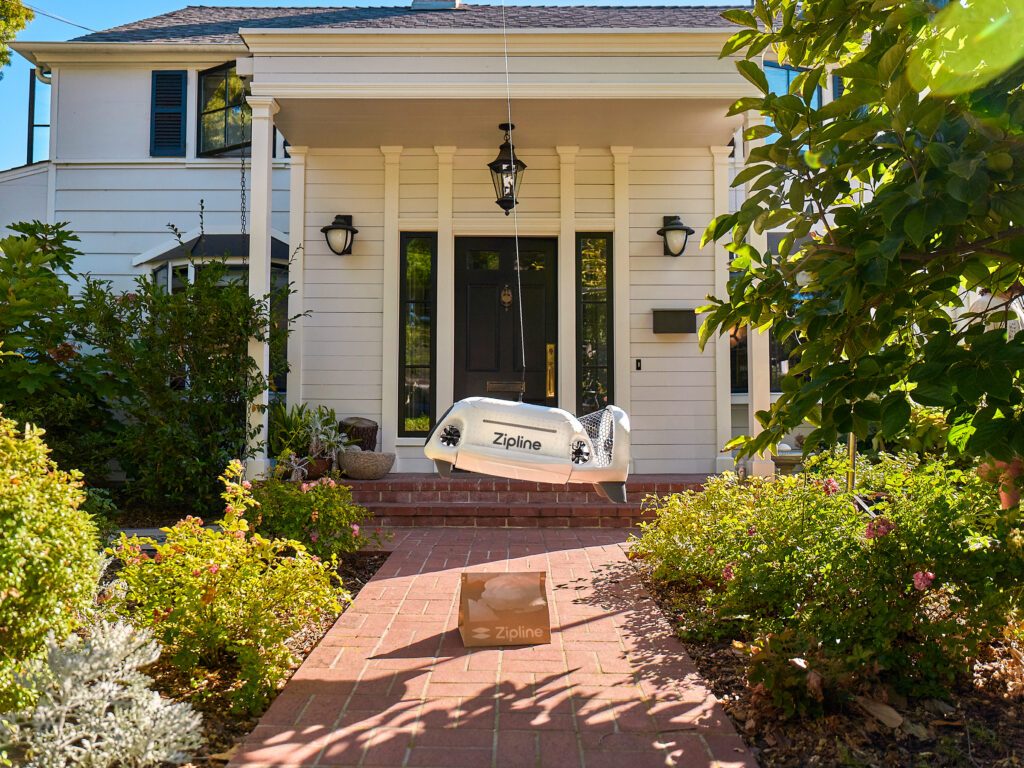
The launch marks another milestone in the growing use of drones for healthcare logistics in the United States. While drone deliveries have supported pilot programs and emergency medical transport, Cleveland Clinic’s initiative represents an operational service integrated into routine patient care.
Initially, the program serves patients within a five-mile radius of Cleveland Clinic’s Beachwood Administrative Campus, which functions as the drone operations hub. Eligible patients who already participate in Cleveland Clinic’s pharmacy home delivery program for certain medications may choose drone delivery at no additional cost.
The health system plans to expand the service over time to additional locations and to transport lab samples, medically tailored meals, and other medical supplies.
Expanding Access to Pharmacy Services
Cleveland Clinic says the program aims to make prescription delivery faster and more convenient while extending the reach of its pharmacy services beyond traditional facilities.
“Cleveland Clinic is committed to exploring innovative ways to improve access and make healthcare more responsive to the needs of our patients,” said Bill Peacock, Executive Vice President and Chief of Operations at Cleveland Clinic. “This drone delivery program is an example of how we can use technology to help patients receive important medications quickly, safely and efficiently.”
Patients whose prescriptions qualify for drone delivery receive notification through Cleveland Clinic’s MyChart patient portal. Controlled substances are not eligible for drone transport.
“Receiving medication quickly and conveniently can make a meaningful difference for patients,” said Lindsey Amerine, Pharm.D., Chief Pharmacy Officer at Cleveland Clinic. “This program is another way in which we’re strengthening home delivery and extending the reach of our services beyond the walls of our facilities.”
How the Delivery System Works
The delivery process differs from traditional drone operations because the aircraft never lands at the patient’s home.
A Cleveland Clinic pharmacy technician places a prescription into a secure drop box at the Beachwood facility. An electric Zipline drone retrieves the package and flies autonomously to the delivery location.
When the drone arrives, it remains up to 300 feet above the ground. A tether lowers a delivery pod containing the prescription to the designated location. After the package is released, the pod returns to the drone, which flies back to its charging station.
Patients can follow the delivery through a tracking link sent in the MyChart messaging portal.
According to Zipline, each aircraft performs more than 500 safety checks every second during flight. Cleveland Clinic and Zipline say they worked together to meet all regulatory and technical requirements before launching the service.
From Global Healthcare to Everyday Deliveries
The Cleveland Clinic program builds on Zipline’s broader healthcare network. Since beginning operations in 2016, the company has delivered tens of millions of medical products worldwide and now serves more than 5,000 hospitals and healthcare facilities.
The company’s U.S. operations have also expanded rapidly beyond healthcare. In Texas, customers can order more than 100,000 products from more than 100 brands, including Walmart, Chipotle, Little Caesars, and numerous locally owned restaurants through the Zipline app. Zipline reports an average order-to-delivery time of 18 minutes, with its fastest deliveries taking just five minutes.
The company now operates commercially in Ohio, Arkansas, and Texas, alongside its international operations. According to Zipline, U.S. deliveries now account for more than 70% of its daily delivery volume.
Zipline President of U.S. Healthcare Hillary Brendzel said the Cleveland Clinic partnership highlights how autonomous delivery can simplify access to care.
“This program between Cleveland Clinic and Zipline makes it easier for patients to access the medicine they need. That’s one less errand to run, and more time back in people’s days. This launch is the latest milestone in Cleveland Clinic’s long history of using innovation to create a better patient experience.”
For Cleveland Clinic, the program represents more than a technology demonstration. By integrating drone delivery into everyday pharmacy operations, the health system is testing whether autonomous aircraft can become a routine part of healthcare logistics while improving convenience and access for patients.
Read more:
Miriam McNabb is the Editor-in-Chief of DRONELIFE and CEO of JobForDrones, a professional drone services marketplace, and a fascinated observer of the emerging drone industry and the regulatory environment for drones. Miriam has penned over 3,000 articles focused on the commercial drone space and is an international speaker and recognized figure in the industry. Miriam has a degree from the University of Chicago and over 20 years of experience in high tech sales and marketing for new technologies.
For drone industry consulting or writing, Email Miriam.
TWITTER:@spaldingbarker
Subscribe to DroneLife here.
When the Federal Communications Commission (FCC) announced on July 21 that it was seeking public comment on whether to prohibit the importation and sale of additional categories of foreign-produced “military-grade” drones, most attention focused on thermal imaging, swarming, and other defense-related capabilities. But one proposed category could have significant implications for agriculture.
The FCC’s Public Notice proposes extending restrictions to several categories of foreign-produced drones on the Covered List, including “aerosol drones capable of dispensing ‘economic poison’” under FAA rules. The legal term “economic poison” refers to pesticides and other agricultural chemicals, meaning the proposed language encompasses agricultural spraying drones as well as any comparable military systems.
That language is particularly relevant because one of the companies identified in the proceeding is Guangzhou XAG Technology (XAG), one of the world’s largest agricultural drone manufacturers. While the FCC has not proposed banning agricultural drones as a category, the inclusion of aerosol-dispensing aircraft means some foreign agricultural platforms could fall within the proposal if adopted.
The proposal also creates an interesting contrast with the FCC’s recent efforts to establish a pathway for trusted agricultural drone suppliers. In recent months, the agency has granted conditional approvals to multiple manufacturers, including Vermont-based Ceres Air, allowing qualifying agricultural drone platforms to continue receiving FCC equipment authorizations under the agency’s exemption process.
Taken together, the actions suggest the FCC is pursuing two parallel objectives: expanding opportunities for trusted suppliers while seeking comment on whether certain categories of foreign-produced drones, including agricultural spray aircraft, should no longer be eligible for importation or sale.
For the agriculture industry, the proceeding bears watching. Precision spraying has become one of the fastest-growing commercial drone applications, and many operators rely on foreign-manufactured aircraft. Whether the FCC ultimately adopts the proposed restrictions, narrows their scope, or creates additional exceptions will likely depend in part on the public comments received before the rulemaking moves forward.
Read more:
Miriam McNabb is the Editor-in-Chief of DRONELIFE and CEO of JobForDrones, a professional drone services marketplace, and a fascinated observer of the emerging drone industry and the regulatory environment for drones. Miriam has penned over 3,000 articles focused on the commercial drone space and is an international speaker and recognized figure in the industry. Miriam has a degree from the University of Chicago and over 20 years of experience in high tech sales and marketing for new technologies.
For drone industry consulting or writing, Email Miriam.
TWITTER:@spaldingbarker
Subscribe to DroneLife here.
By DRONELIFE Features Editor Jim Magill
Since the start of the World Cup last month, federal law enforcement agencies have reported seizing more than 600 drones flying too close to the sites of tournament matches and fan zones.
Yet those seizures represent just the beginning of the necessary investigations to determine whether the operators of those UAVs were carelessly violating restricted airspace or doing so with much more hostile intentions in mind. In the latter case seizing the drone is only the first step in bringing the perpetrators of the crime to justice.
Seeking to provide the key to helping law enforcement agencies collect the evidence needed to make their cases, SkySafe, a U.S. drone-detection and airspace-intelligence company, recently partnered with Israel-based Cellebrite, a provider digital of investigative and intelligence solutions.
The companies say their exclusive partnership will combine Cellebrite’s advanced digital forensics with SkySafe’s advanced drone detection technology.
“I think that the key thing here is that now there are a lot more things involved in investigations beyond just mobile phones, and drones are one of the critical ones that are popping up in more and more incidents,” SkySafe CEO Grant Jordan said in an interview.
He said that in addition to SkySafe’s drone awareness capabilities, the Cellebrite partnership will enable the company “to help in the investigative side, pulling all of the information about what that drone was doing, where have we seen it in the past, and merging that with the digital-forensic artifacts that come from that drone.”
David Gee, chief marketing officer at Cellebrite, said that for law enforcement officials, the investigative work begins once have they have the drone in their possession.
“Once the drone has been mitigated and you have the drone physically, we have a device that you attach it to, which does the access and extraction. So, you have some real-time data physically from the drone of whatever was in the drone’s memory,” he said.
“But what’s important here is also combining that with what SkySafe does, which is historical drone information, which is not just the information that’s physically on the drone, but the database and the records and the tracking that the SkySafe team have access to,” Gee said.
Combining the forensic data extracted from the drone itself with the information in SkySafe’s database allows investigators to get the historical references such as where that drone has flown, its ownership and other salient data points that go into an investigative process.
Cellebrite’s background in cell phone investigations
Cellebrite is a public company, listed on the Nasdaq, with a market cap of about $4 billion. Founded in 1999, for much of the past 20 years of its history, the company had focused on creating technology that enabled sanctioned law enforcement officials to be able to access, extract, decode and analyze data from mobile phones.
“Your phone is your digital twin. When something bad happens, we are a post-event technology, meaning your phone becomes part of an investigation,” Gee said.
Working with more than 7,000 law enforcement agencies, defense and intelligence organizations across the globe, Cellebrite uses its artificial intelligence (AI)-powered software to accelerate more than 1.5 million legally sanctioned investigations annually.
In March, Cellebrite completed its acquisition of SCG Canada, a provider of hand-held digital forensics tools that enable access to more than 80 of the most commonly deployed UAVs. In much the same way that Cellebrite’s software allows it to extract data from cellular phones, SCG’s technology enables the company to perform extraction, decoding and visualization of millions of data points from seized drones.
“What we do is once the drone is down, we can interrogate that drone and understand: where it was, where did it fly, what did it do, did it go up, down, sideways, left, right?” Gee said. The software can determine, based on its acceleration-deceleration changes, whether the drone was carrying a payload and whether it dropped that payload.
Such information could prove vital in a case involving a drone suspected of dropping off a payload of contraband over a prison, for example. In another case, involving a drone downed after flying too close to a World Cup site, the software could help determine whether the pilot was simply an irresponsible teen hoping to get some cool aerial shots for his social media page, or if the UAV have overflown the same site a dozen or more times, indicating it was being used for surveillance for more nefarious purposes.
Technology expected to aid in rules enforcement
Jordan said the partnership with Cellebrite would enhance the suite of services that SkySafe currently offers its customers, many of whom are also customers of Cellebrite. He said this is especially true in the case of solving the growing problem of drones being used to deliver contraband into prisons.
“We’ve seen dozens of cases where our tracking and the forensics work have come together to solve and to prosecute cases where prisons have had drone incidents of smuggling,” he said. “That’s probably one of the most immediate high-impact areas that we’ve seen for bringing together these worlds of traditional digital forensics and drone-awareness technology.”
Another area in which the combination of airspace-awareness and digital forensics technologies is expected to have a more prominent role in the future is in protecting critical infrastructure sites from unwanted drone incursions, he said. He pointed to the FAA’s efforts to institute Section 2209, designed to allow owners and operators of important fixed sites to request that flight restrictions be imposed over their facilities.
“I think part of the way to think about this is there’s the question of overall awareness and management of our national airspace,” he said. “And then after the fact is the investigative side, the law enforcement side, where they are trying to actually enforce the rules of the road so that good operators can do their commercial operations with drones safely and the public can be safe.”
Read more:

Jim Magill is a Houston-based writer with almost a quarter-century of experience covering technical and economic developments in the oil and gas industry. After retiring in December 2019 as a senior editor with S&P Global Platts, Jim began writing about emerging technologies, such as artificial intelligence, robots and drones, and the ways in which they’re contributing to our society. In addition to DroneLife, Jim is a contributor to Forbes.com and his work has appeared in the Houston Chronicle, U.S. News & World Report, and Unmanned Systems, a publication of the Association for Unmanned Vehicle Systems International
BRINC announced July 14, 2026, a $125 million financing round led by Motorola Solutions, with participation from Index Ventures and Dylan Field, chief executive and founder of Figma. The Seattle-based public safety drone maker says the investment brings its total capital raised to well over a quarter billion dollars and will help deploy a BRINC 911 response drone at every police and fire station across the United States, an addressable base of 80,000 facilities.
Where the $125M will go
BRINC will use the capital to expand domestic manufacturing, launch new products and scale go-to-market operations, according to the company. By the end of 2026, BRINC will move into a facility three times the size of its current factory. The company says the expansion is needed to meet surging demand from public safety agencies.
BRINC tripled revenue and quintupled monthly production capacity in 2025, according to the announcement. In 2026, it has signed nearly four times as many 911 response drone contracts as it did over the same period a year earlier, with customers including the Los Angeles Fire Department, the St. Louis Police Department and hundreds of others.
CEO on the funding round
“Every second matters in an emergency,” said Blake Resnick, founder and chief executive of BRINC. “Our 911 response drones put eyes on scene before first responders arrive, giving everyone the situational awareness they need to act decisively and keep people safe. This investment enables our organization to build more products, expand our manufacturing capacity, and put a drone on the roof of every police and fire station in America.”

The BRINC product lineup
BRINC positions three aircraft across the response stack. According to the company, the Responder “leads the market in time on scene.” Lemur 2 is described as “the most capable indoor drone.” Guardian is “the 911 response drone built to replace helicopters.” BRINC says exclusive integrations with Motorola Solutions and interoperability with other public safety technology providers make every product “just a button-press away.”
About BRINC
BRINC manufactures its products in the United States, co-locates R&D with production and is vertically integrated across its supply chain. More than 900 public safety agencies use BRINC products, including more than 20 percent of U.S. SWAT teams. Backers include Sam Altman, Index Ventures, Motorola Solutions, Dylan Field, Elad Gil, Patrick Shanahan, Julius Genachowski, Shyam Sankar, Alexandr Wang, Bradley Tusk and Jeff Weiner.
The company is also currently partnering with the National League of Cities on a nationwide DFR rollout.
More information is available at BRINC.
Read more:
Ian McNabb is a journalist focusing on drone technology and lifestyle content at Dronelife. He is based between Boston and NH and, when not writing, enjoys hiking and Boston area sports.