
As drones fill the low-altitude sky, security teams can see that something is flying but rarely know what it is. Andromeda fuses data from radar, RF, optical, acoustic, Remote ID and other detection systems into one operational picture, giving homeland security teams real-time Identification Friend or Foe (IFF).
Drones are increasingly common around critical civilian sites. Identifying authorized flights versus potential threats in real time is critical. Today, High Lander introduced Andromeda, an airspace security software layer that fuses multi-sensor detection feeds
into a unified operational picture. Andromeda provides real-time Identification Friend or Foe (IFF) and correlates data sources to help operators assess risk and coordinate responses.
Sensors Everywhere, No Shared Picture
Most site-security organizations operate disparate detection equipment, resulting in fragmented information feeds that force operators to monitor multiple unintegrated displays. The primary challenge is not sensor availability, but the lack of an integrating
layer.
Andromeda addresses this by using Sensor Fusion to merge data from radar, RF, Remote ID, ADS-B, optical and acoustic sensors, telemetry, and third-party systems into a single common operating picture. Cross-referencing these inputs eliminates duplicate detections, improves identification accuracy, and replaces multiple screens with one.
That unified picture also creates intelligence over time. Andromeda can correlate recurring activity across locations and events, helping operators identify patterns that may not be meaningful when viewed as isolated detections. A drone appearing near one sensitive site today and another tomorrow can become part of a wider operational picture rather than a series of disconnected alerts.
Telling Blue From Red, friend from enemy
In security terms, authorized civilian drones are “blue.” They broadcast their position and identity, fly within the rules, and are connected to UTM. Hostile, unidentified or unauthorized drones are “red.” The ability to separate one from the other, continuously
and in real time, is Identification Friend or Foe (IFF).
Andromeda bases airspace security on distinguishing authorized traffic from threats. Without recognizing legitimate drones, a security system risks misidentifying every unknown aircraft, hindering enforcement and scaling. High Lander addresses this using
Vega UTM to manage authorized flight plans, identified aircraft, and legitimate traffic. Andromeda provides the detection and security layer, enabling operators to compare expected airspace activity against actual detections.
Alon Abelson, CEO and co-founder of High Lander said:
“The threat to low-altitude airspace is no longer a future scenario. It is already here and continues to grow. Alongside detection systems, organizations today need a smart software layer that can bring all the data together, distinguish between legitimate traffic and potential threats, and provide decision-makers with one clear and reliable picture,”.
A Global Problem
The threat to low-altitude airspace is no longer theoretical, and it is no longer confined to the battlefield. In January 2026, a drone struck the wing of a Ukrainian aircraft at Leipzig Airport, Germany, demonstrating how quickly an unidentified aircraft can
become a threat to civilian aviation. During the January 2025 Palisades fires in Los Angeles, an unauthorized civilian drone collided with a firefighting aircraft and forced it out of service. Recent military operations have exposed another dimension of the
problem: drones can be concealed, transported and launched from within a country’s own territory, making their point of origin increasingly difficult to predict.
Detecting drones is insufficient; security teams must discern authorization, assess risk, and determine necessary action. As civilian drone use grows, safeguarding key sites requires a unified operational picture of both authorized flights and potential threats.
Neutral, Drone-Agnostic and Sovereign
Hardware- and platform-agnostic, Andromeda operates on-premises or in the cloud without vendor lock-in. Organizations supply sensors while Andromeda delivers the air picture, integrating with High Lander’s Vega UTM and Orion DFM so operators can
manage flights and address threats in one system. Customers retain full data ownership with zero third-party transfers, backed by ISO 27001, 9001, and 29001 certifications.
About High Lander
High Lander was established in 2018 by aviation veterans and technology experts to enable a fully integrated sky where crewed and uncrewed aircraft operate in harmony.
The company provides software-only solutions for the new era of aviation: Orion DFM, a hardware-agnostic drone fleet management platform, and Vega UTM, a next-generation traffic management platform that supplies the infrastructure for safe,
unified aviation. With Andromeda, High Lander extends this foundation into airspace security, giving homeland security and public safety organizations a single, drone-agnostic picture of the low-altitude sky.
Related
Discover more from sUAS News
Subscribe to get the latest posts sent to your email.

- Strategic partnership targeting one million drone deliveries daily by the end of 2029, with first deliveries later this year.
- Drone delivery on Uber Eats will launch across existing Zipline markets and target expansion into dozens of US cities.
- Uber to make a strategic investment in Zipline, reinforcing a long-term partnership to accelerate the scale of drone delivery.
Zipline, a leader in drone delivery, and Uber Technologies, Inc. (NYSE: UBER) today announced a strategic partnership, which aims to scale drone delivery across the United States.
The first deployments will begin later this year, where Uber Eats customers will have the option to receive their orders in minutes via Zipline’s autonomous drone delivery.
Uber will also make a strategic investment in Zipline and, together, the companies aim to reach one million drone deliveries per day by the end of 2029.
Zipline operates on 4 continents and makes a delivery every 20 seconds. The company spent 10 years building an international logistics network that serves more than 5,000 hospitals, saves more than 12,000 lives each year, and has flown more than 135 million autonomous miles. Now the company is bringing this technology and service to the U.S. to deliver anything people need in 5-10 mins. Zipline has made more than 2.7 million deliveries of more than 20 million items, reducing traffic, carbon emissions and saving people time with each delivery.
Uber is building the world’s most flexible hybrid delivery network, seamlessly integrating couriers, sidewalk robots, and drones to match every delivery with the best mode of transportation. This partnership combines the superpowers of both companies – offering Zipline’s quiet, ultra-fast, precise delivery to millions of Uber Eats customers and hundreds of thousands of small businesses. Together, Uber and Zipline will accelerate the adoption of drone delivery at scale, bringing fast and affordable autonomous deliveries to millions more consumers.
“Zipline has built incredible technology, and Uber connects many millions of people with local merchants every day,” said Dara Khosrowshahi, CEO of Uber. “Together, we’re shaping the future of delivery by creating a faster, more sustainable way for people to get what they need. We look forward to bringing this technology to more communities and making autonomous delivery part of everyday life.”
“Teleportation isn’t science fiction anymore. It’s becoming part of everyday life,” said Keller Cliffton, Co-Founder of Zipline. “Every great transportation revolution has changed where people live, how businesses operate, and how economies grow. Together with Uber, we’re taking the next step toward building a world where getting what you need is as fast and effortless as sending a text, no matter where you are.”
Drones have the potential to transform delivery by cutting delivery times, costs, and emissions compared with traditional methods, making it possible for everything from dinner to daily essentials to arrive at your doorstep in a matter of minutes.
Related
Discover more from sUAS News
Subscribe to get the latest posts sent to your email.
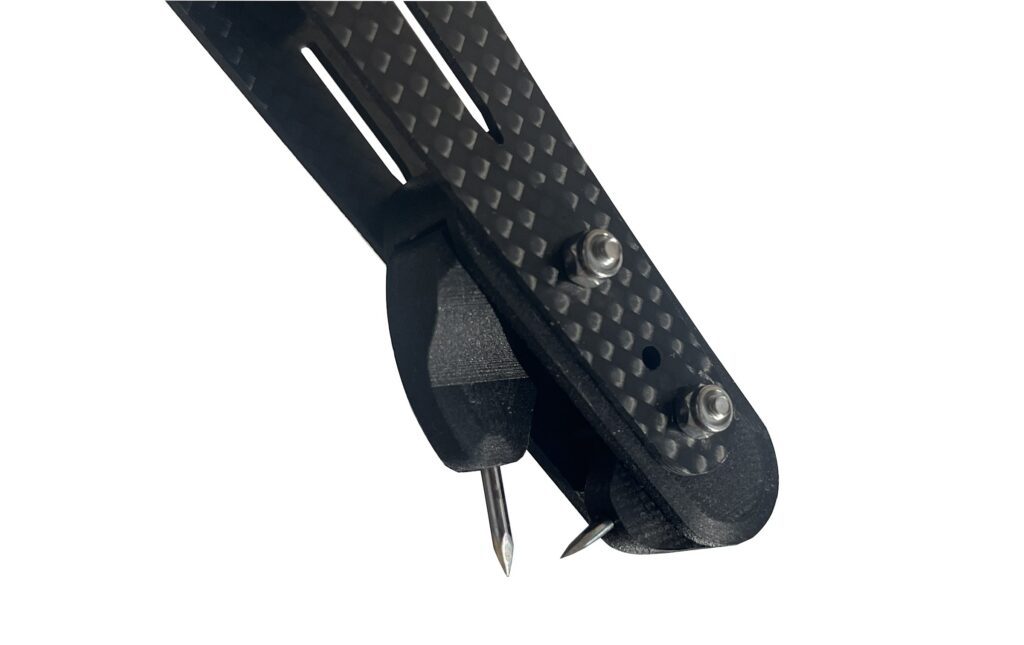
Cats may seem an unlikely source of inspiration for drone landing gear. But retractable claws helped researchers at Canada’s Université de Sherbrooke address a difficult problem: landing a drone on steep, slippery ice.

The result is the Ice Dart, a multirotor designed to land and remain perched on steep ice surfaces.
Researchers Isaac Tunney, John Bass, and Alexis Lussier Desbiens developed the system at Université de Sherbrooke. Their work was published in IEEE Transactions on Field Robotics as “The Ice Dart: Landing on Steep Ice Using Spiny Feet, Dissipative Landing Gear and Reverse Thrust.”
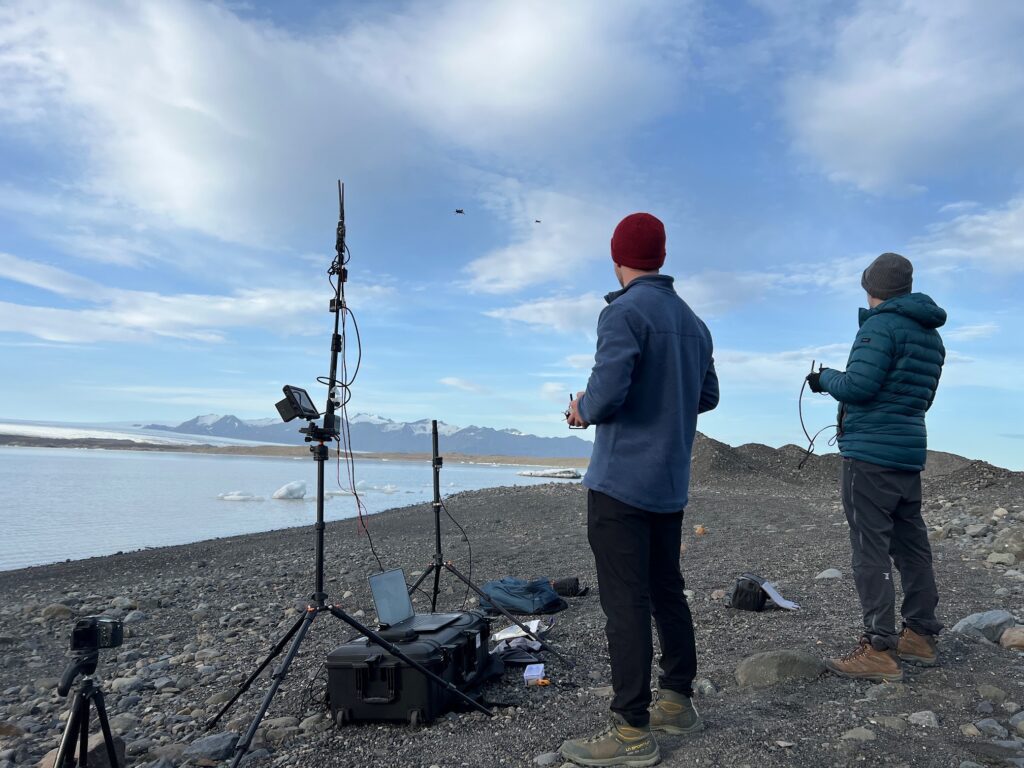
The team tested Ice Dart on natural icebergs and glaciers in Iceland. Across 24 field landings, the aircraft handled slopes of up to 58 degrees and winds exceeding 30 km/h, according to information provided by the researchers. Controlled testing demonstrated landings on ice slopes of up to 60 degrees and touchdown speeds of up to 3 meters per second.
Claws, Shock Absorption and Reverse Thrust
Landing on steep ice requires the aircraft to absorb the impact while gaining enough grip to avoid sliding or tipping.
Ice Dart combines three approaches.
Retractable spines inspired by a cat’s claws deploy during landing to grip the ice. Friction-based landing gear dissipates energy during impact. The aircraft also uses reverse thrust at touchdown to help stabilize the landing.
Together, these technologies expand the conditions in which a multirotor can land.
Ice Dart builds on earlier research by the same Université de Sherbrooke team. Tunney, Bass, and Lussier Desbiens have studied methods for landing multirotors on steep surfaces and high-speed moving vehicles. Their previous work also used friction shock absorbers and reverse thrust to increase the landing envelope.
The Ice Dart takes that research into a particularly difficult natural environment.
Landing Instead of Hovering
The ability to land on ice could also extend the usefulness of small drones for sensing missions.
A multirotor must continuously power its motors while hovering. Landing allows it to remain in place without using energy to stay airborne. This could allow a drone to serve as a temporary sensing station on an iceberg or other natural surface.
Potential applications identified by the researchers include iceberg tracking, maritime safety, environmental research, and Arctic surveillance and domain awareness.
The Iceland trials demonstrate the system outside controlled laboratory conditions, including on irregular natural ice and in wind.
More broadly, Ice Dart is part of the Université de Sherbrooke team’s effort to expand where multirotor drones can land. The researchers have previously demonstrated landings on moving boats, vehicles traveling at high speeds, and steep rooftops.
With Ice Dart, they have added glaciers and icebergs to that list.
Research: The Ice Dart: Landing on Steep Ice Using Spiny Feet, Dissipative Landing Gear and Reverse Thrust, Isaac Tunney, John Bass and Alexis Lussier Desbiens, IEEE Transactions on Field Robotics.
Read more:

Miriam McNabb is the Editor-in-Chief of DRONELIFE and CEO of JobForDrones, a professional drone services marketplace, and a fascinated observer of the emerging drone industry and the regulatory environment for drones. Miriam has penned over 3,000 articles focused on the commercial drone space and is an international speaker and recognized figure in the industry. Miriam has a degree from the University of Chicago and over 20 years of experience in high tech sales and marketing for new technologies.
For drone industry consulting or writing, Email Miriam.
TWITTER:@spaldingbarker
Subscribe to DroneLife here.

British Transport Police (BTP) has completed the first phase of its pioneering ‘Drone in a Box’ (DIAB) project with seven operational sites now live, further enhancing its ability to respond to trespass and emergency incidents.
The project has been delivered through BTP’s innovative Drones Development Programme, which is focused on integrating Beyond Visual Line of Sight (BVLOS) drone technology into the force’s wider operational capabilities. The technology enables drones to be launched and piloted remotely from a London-based control room, providing officers and Network Rail staff on the ground with live aerial intelligence within seconds.
BTP BVLOS drones are operated under a comprehensive ‘Safety Management System’ to ensure our operations are safe to the aviation community as well as those on the ground. We continue to work closely with the regulator, the Civil Aviation Authority, as we further develop our capability.
Since launching our first site in Leeds in April 2025, four sites have been introduced across south London, as well as Leicester and Manchester.
These locations are known trespass hotspots and deployment of the DIAB forms part of BTP’s continued investment in innovative technology to keep everyone on the railway safe, reduce risk for officers and railway staff, and keep the network moving.
Between 1 April and 25 July, BTP’s Drone in a Box Capability conducted 550 flights. During that period, drones were the first resource on scene in 68% of operational incidents, with an average response time of just three minutes and 28 seconds.
The technology has already delivered tangible benefits for passengers and the rail industry. In the same reporting period, drone deployments have helped prevent an estimated 7,911 delay minutes and delivered more than £600,000 in potential disruption savings to the railway.
The tech is also proving invaluable in the search for vulnerable people and in quickly assessing reports of trespass, allowing officers to focus their resources where they are most needed. 20% of operational deployments to date have been to assist vulnerable people, while 44% of operational deployments to date were resolved through area searches which confirmed no trace of a reported person, enabling railway services to continue running safely without unnecessary disruption.
Recent deployments have included assisting officers during the containment of a suspected burglar near East Croydon, locating a lineside fire near Hither Green and helping safeguard a person in crisis near Thornton Heath by providing officers with their precise location.
Speaking at a specially held event at one of the site locations in Manchester, BTP Chief Constable Lucy D’Orsi said: “We’re just over a year on from our first site launch in Leeds and it’s great to see that our remote BVLOS drone capability is helping us reach incidents faster, make better-informed decisions and minimise disruption to the railway while keeping people safe.
“I’ve no doubt this capability will become even more instrumental as we continue to learn and fine tune from every deployment. We couldn’t do it without the support of our partners at Network Rail and the Department of Transport Operator (DfTO), who’ve been instrumental in working with us throughout.
“We’re going to continue to invest in the capability to ensure it’s the best it possibly can be, with a planned move to a new flight operations room in London, and further sites scheduled to open in the coming months.”
Rupert Lown, Group Safety, Security, Health & Environment Director, DFTO, said: “The rollout of these cutting-edge drones is making a real difference to more and more customers across the network. Drones are enabling rapid identification and response to dangerous incidents such as trespass and can resolve incidents that often cause frustrating delays for customers before they can occur.
“Closer collaboration between train operators, Network Rail and BTP is helping to deliver a better, more reliable and safe railway for everyone in Britain.”
Related
Discover more from sUAS News
Subscribe to get the latest posts sent to your email.
Saildrone announced a major European expansion on August 18, 2026, from its new EU headquarters in Copenhagen. The expansion includes three build contracts across Northern Europe. Van Der Valk Shipyard in the Netherlands will build the first European-produced 52-meter (171-foot) Saildrone Spectre. Umoe Mandal in Norway will produce the next-generation Surveyor and Southern Spars in Poland will build its wings. The investments target Saildrone unmanned surface vehicles (USVs) for European customers.
“We are proud to announce not one, but three large construction projects. The first European-built 52-meter Saildrone Spectre will be built at Van Der Valk Shipyard in the Netherlands; the next generation of the Saildrone Surveyor will be produced at Umoe Mandal in Norway; and Southern Spars will produce Surveyor wings in Poland,” said Richard Jenkins, Saildrone founder and CEO. “Our EU Headquarters in Copenhagen will facilitate business development, maintenance operations, and piloting activities throughout our European operations.”
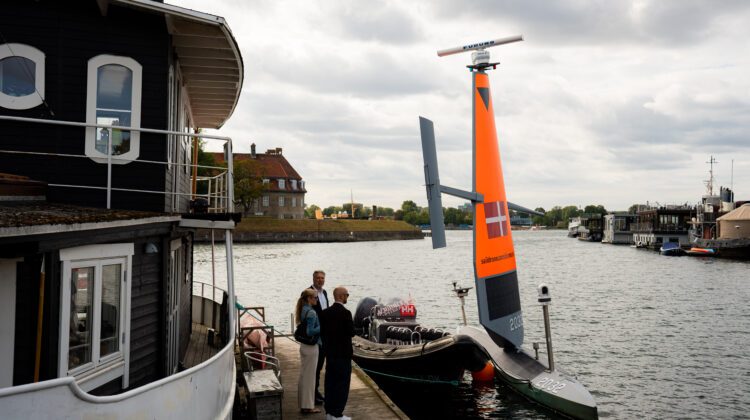
Copenhagen EU headquarters
The Copenhagen office sits at Quintus Bastion in Holmen, a 17th-century former Royal Danish Navy headquarters. New roles cover Mission Management, Vehicle Assembly and Service, Technical Operations and the Pilot Team. Defence Industry Attaché, His Royal Highness Brigadier General Prince Joachim of Denmark officiated the ribbon-cutting ceremony on August 17.
“It is fantastic to see Saildrone’s European headquarters located here in this historic naval site in Central Copenhagen,” said Prince Joachim. “Saildrone brings some of the latest maritime sensing technology to Denmark, which will certainly help protect our shared European waters against the many real threats we face today.”
Sovereign capability for European partners
Saildrone established its European subsidiary in April 2025. A $60 million funding round led by EIFO, the Export and Investment Fund of Denmark, backed the subsidiary. Four Saildrone Voyager USVs completed a six-month Danish Ministry of Defence deployment with 92% fleet uptime. The vehicles detected more than 170,000 unique contacts in harsh weather. Saildrone operates a fleet of more than 70 USVs across four classes. The classes include the 7-meter (23-foot) Explorer, 10-meter (33-foot) Voyager, 20-meter (66-foot) Surveyor and 52-meter Spectre.
“Saildrone USVs have helped governments around the world to improve maritime domain awareness, counter drug trafficking, migrant crossings, and illegal fishing, and protect critical marine infrastructure,” said Robert Kleist, managing director of Saildrone Europe. “We are pleased to bring that proven capability to our European partners facing many of the same challenges. Bringing Saildrone manufacturing and operations to Europe creates an enduring sovereign capability for our European customers.”
Saildrone participates in DALO Industry Days in Herning on August 19-20, 2026. More information is available at Saildrone.
Read More

Ian McNabb is a journalist focusing on drone technology and lifestyle content at Dronelife. He is based between Boston and NH and, when not writing, enjoys hiking and Boston area sports.

YARI V6X is an enterprise-grade FMUv6X modular flight controller and autopilot platform for demanding small unmanned vehicle missions. It is designed and built in India for teams developing copters, planes, VTOLs, rovers, boats, underwater ROVs, and other robotics platforms.
V6X is built for developers, system integrators, manufacturers, research teams, defense teams, commercial operators, and builders who need reliable onboard flight-control hardware without leaving the PX4 and ArduPilot ecosystems.
Why We Built V6X
Small unmanned vehicle teams often work at the boundary between open-source autopilot software, custom payloads, companion computers, sensors, radios, power systems, and field conditions that are rarely gentle.
The flight controller sits at the center of that system. It has to handle vehicle state estimation, sensor timing, vibration, logging, power transitions, firmware updates, and integration with the rest of the autonomy stack.
YARI V6X was built to give teams a modern, serviceable, Pixhawk-compatible platform for that work. It follows the FMUv6X and Pixhawk Autopilot Bus open standards, while adding YARI’s own focus on sensor isolation, vibration performance, active IMU thermal stabilization, rugged packaging, documentation, and field validation.
Built On Open Autopilot Standards
V6X is based on the FMUv6X and Pixhawk Autopilot Bus standards. The standard set includes the YARI V6X Flight Controller Module and the YARI Pixhawk Autopilot Bus Carrier, giving teams a modular autopilot platform that can fit into Pixhawk-compatible workflows.
The product ships with ArduPilot support and can be flashed with PX4. YARI V6X board support is already merged into ArduPilot master, and supported firmware downloads are available from the YARI documentation site while official release and ground-station packaging catches up.
That matters because teams do not need to choose between a modern hardware platform and familiar autopilot workflows. V6X is designed to work with the tools, firmware projects, and integration patterns that unmanned vehicle teams already use.
Hardware Designed For Demanding Missions
YARI V6X combines redundant sensing, thermal control, vibration isolation, and high-performance flight computation in a compact autopilot platform.
Key hardware highlights include:
- STM32H743 MCU running up to 480 MHz.
- Modular FMU, IMU, and PAB carrier architecture.
- 3x IIM-42653 SmartIndustrial IMU array with extended temperature support.
- Redundant isolated sensor domains with dedicated communication buses and independent power control.
- Active IMU heating for consistent sensor performance across changing environmental conditions.
- Custom vibration-isolation material for high-vibration airframes.
- CNC-machined aluminum flight-controller enclosure.
- Ethernet, additional telemetry, debug, and integration interfaces on the YARI carrier board.
Tested In The Field And In The Lab
YARI V6X has been validated through field flight testing and NABL-accredited lab testing. The product has cleared environmental and EMC testing in NABL-accredited labs, with tests performed in operational condition with continuous data logging where applicable.
EMC testing covered CISPR 32 conducted emissions, CISPR 32 radiated emissions, IEC 61000-4-2 ESD immunity, and IEC 61000-4-3 radiated immunity.
Environmental testing covered IEC 60068 low air pressure, cold, dry heat, temperature change, random vibration, shock, and damp heat cyclic methods.
Full test reports are available upon request for qualified customers, integrators, and enterprise evaluations.
Designed And Built In India
YARI V6X is designed and built in India. For V6X, that means significant manufacturing value add happens through our India-based network, including activities such as PCB fabrication, PCB assembly, final assembly, testing, packaging, and related manufacturing operations depending on the production stage and component availability.
Electronic components such as ICs, passives, and semiconductors may be sourced globally based on availability and technical requirements. But the product direction, integration, validation, and manufacturing value add are rooted in India.
That matters to us because small unmanned vehicle teams need dependable hardware, clear documentation, and an engineering team that understands the product beyond a reseller catalog.
Documentation, Firmware, And Integration Support
A flight controller is only useful when teams can actually integrate it, update it, debug it, and ship vehicles with it.
The YARI documentation site includes V6X overview, setup, downloads, FAQ, pinout, troubleshooting, compliance and testing summaries, firmware downloads, CAD files, and datasheet links. Supported downloads include ArduPilot firmware for Copter, Plane, Rover, and Sub, PX4 firmware variants, bootloaders, CAD models, and the V6X datasheet.
V6X also supports Ethernet workflows for MAVLink connectivity with direct PC, companion-computer, and ground-station setups. That gives teams another practical path for integration, especially when vehicles use companion computers or more demanding payload and data workflows.
Built Through Field Testing, Automation, And Iteration
Before launch, YARI V6X went through repeated field flights, thermal checks, vibration-focused testing, automated hardware validation, and endurance runs. That work shaped the product and helped us validate the controller as a serious platform for demanding unmanned vehicle development.
The validation work included stable hover flights, high-vibration stress testing, mission-style flight reviews, onboard IMU-heater checks, ArduPilot hardware report reviews, and full-system flights with YARI V6X, YARI GNSS, YARI Power Module, and AM32 ESC hardware working together.
We also built internal hardware test automation around V6X. That included automated serial-port validation, custom test jig development, custom test firmware, close to 100% hardware test coverage, and a week-long endurance run with continuous onboard SD-card logging.
Most field-flight validation so far has been on multicopter platforms. Our next focus is to keep expanding validation across more vehicle types, scale production, and streamline the processes around testing, assembly, documentation, and support.
V6X is the first product we are bringing to market, but it is not a one-off board. It is the onboard hardware foundation for the broader YARI product stack around small unmanned vehicles, autonomy development, and reliable field operations.
Built On Shared Foundations
YARI V6X stands on the shoulders of open-source autopilot projects and hardware standards including PX4, ArduPilot, and Pixhawk. We inherited good design concepts that already exist in the ecosystem instead of reinventing the wheel, and built on those foundations to create a reliable, documented, and indigenized flight-controller platform for YARI’s autonomy stack.
We are grateful to the open-source contributors and maintainers whose work made this possible, including the maintainers who reviewed and helped merge YARI V6X board support. For us, this foundation matters because dependable onboard hardware is one of the critical building blocks for small unmanned vehicles, autonomy development, and field operations.
Availability
YARI V6X pre-orders open on August 15, 2026, with worldwide shipping. Pre-order units are expected to ship in about 2 months.
Pre-orders help us get the first production cycle started. As we scale, the goal is to improve demand forecasting, lock in long-lead-time components earlier, manufacture larger batches, and keep YARI V6X inventory in stock more consistently.
Pre-order customers receive a 10% launch discount. B2C customers can place orders directly through the portal. For B2B or bulk orders, email [email protected].
Related
Discover more from sUAS News
Subscribe to get the latest posts sent to your email.

BY THE PRESIDENT OF THE UNITED STATES OF AMERICA
A PROCLAMATION
1. Within the past 90 days, the Secretary of Commerce (Secretary) transmitted to me a report on his investigation into the effects of imports of unmanned aircraft systems (UAS), as well as their parts and components (together, UAS components), on the national security of the United States under section 232 of the Trade Expansion Act of 1962, as amended, 19 U.S.C. 1862 (section 232). Based on the facts considered in that investigation, and taking into account the close relation of the economic welfare of the Nation to our national security and other relevant factors, see section 232(d) (19 U.S.C. 1862(d)), the Secretary found and advised me of his opinion that UAS and UAS components are being imported into the United States in such quantities and under such circumstances as to threaten to impair the national security of the United States and provided recommendations for action under section 232 to adjust the imports of UAS and UAS components so that such imports will not threaten to impair the national security of the United States.
2. Among other things, the Secretary found that UAS and UAS components are essential to the national and economic security of the United States. UAS are a key technology in modern armed conflict and are critical for present and future U.S. military operations. They have proven essential in recent conflicts, as low-cost UAS are able to inflict significant damage on far more expensive weapons systems, facilities, and infrastructure. UAS are used by many executive departments and agencies (agencies) for purposes of law enforcement, scientific research, environmental monitoring, aerial mapping, surveillance, agriculture, disaster relief, and search and rescue. Further, UAS are used to protect critical infrastructure against adversaries that seek to damage or gain information on the operations of critical infrastructure installations throughout the United States, safeguarding U.S. national and economic security. And UAS are widely used by private companies and State and local governments for critical applications, such as agriculture, emergency and first response, telecommunications, energy, construction, and transportation and delivery.
3. The Secretary found that import penetration from foreign producers of UAS is substantial and that the United States is too reliant on foreign sources of UAS and UAS components. Import reliance creates strategic vulnerabilities, presenting risks that disruption or delays due to a geopolitical event or natural disaster would affect global transportation and trade. Most commercial and industrial UAS, even those produced in the United States, incorporate critical parts and components produced overseas. For example, many U.S. commercial manufacturers that produce UAS domestically are highly dependent on foreign sources for critical UAS components, such as motors, electronic speed controllers, lithium-ion batteries, and docking stations, which creates unacceptable national security vulnerabilities. Such reliance poses significant risks to U.S. national security through our dependence on unreliable supply chains for an essential technology and the potential of significant cybersecurity vulnerabilities.
4. In addition, the Secretary found that UAS and UAS components from certain foreign entities pose security and safety risks. Such products pose an information technology security risk because their software allows data to be sent back to the manufacturer in a foreign country, which can then be exploited by the government of that foreign country. Operators cannot control this data flow because it is integrated into the UAS factory installed operating system.
5. The Secretary also found that the domestic industry does not produce enough UAS and UAS components to safely meet national security needs and that the need and demand for domestically produced UAS and UAS components will only increase. As it stands, there are concerns as to whether the U.S. industry can produce UAS and UAS components at the required speed and scale to adequately support national security operations and activities, including during a surge for wartime or armed conflict, or in a manner to sustain long-term economic competitiveness. In the Secretary’s opinion, domestic capacity needs to be expanded rapidly for end products, components, and subcomponents to meet anticipated military and commercial requirements and to ensure the economic competitiveness of the United States.
6. The Secretary further found that foreign imports and unfair trade practices, without intervention, will continue to harm the United States, UAS industry, and industries that rely on the U.S. UAS industry. In the Secretary’s view, this hinders the incentives for U.S. producers to invest in developing and expanding manufacturing capacity, production, and their workforce.
7. In light of these findings and the other findings in the Secretary’s report, the Secretary recommended actions to adjust the imports of UAS and UAS components so that such imports will not threaten to impair the national security. For example, the Secretary recommended a high ad valorem duty on UAS with a maximum take-off weight of more than 25 kilograms, because those UAS can more easily be used for weapons-related purposes and are more likely to have sophisticated technologies for surveillance. The Secretary recommended imposing the same high ad valorem tariff on UAS docking stations, as they can be used to control autonomous UAS systems that are typically deployed around U.S. critical infrastructure. The Secretary recommended a lower ad valorem duty on UAS with a maximum take‑off weight of 25 kilograms or less. The Secretary recommended a lower ad valorem duty on certain critical UAS components, which would become effective after a temporary delay, to allow time for greater domestic production of these products. The Secretary also recommended that the Department of Commerce be authorized to establish an onshoring program for UAS and UAS components that provides preferential tariff treatment to companies that commit to building new U.S. manufacturing facilities for UAS and UAS components.
8. After considering the Secretary’s report, the factors in section 232(d) (19 U.S.C. 1862(d)), and other relevant factors and information, I concur with the Secretary’s finding that UAS and UAS components are being imported into the United States in such quantities and under such circumstances as to threaten to impair the national security of the United States. In my judgment, and in light of the Secretary’s report, the factors in section 232(d) (19 U.S.C. 1862(d)), and other relevant factors and information, I determine that it is necessary and appropriate to adopt a plan of action, as described below, to adjust the imports of UAS and UAS components so that such imports will not threaten to impair the national security of the United States.
9. I determine that it is necessary and appropriate to impose ad valorem duties on certain UAS and UAS components. Specifically, I determine that it is necessary and appropriate to impose a 100 percent ad valorem duty rate on the import of UAS with a maximum take-off weight of more than 25 kilograms, UAS that integrate thermal imagers, UAS docking stations, and certain UAS components, as identified in Annex I to this proclamation, and except as otherwise provided in this proclamation. In addition, I determine that it is necessary and appropriate to impose a 25 percent ad valorem duty rate on imports of UAS with a maximum take-off weight of 25 kilograms or less, as identified in Annex II to this proclamation, and except as otherwise provided in this proclamation.
10. I determine that it is necessary and appropriate to impose a 25 percent ad valorem duty rate on imports of certain UAS components, as identified in Annex III to this proclamation, and except as otherwise provided in this proclamation. This duty will take effect 180 days from the date of this proclamation to incentivize production onshoring.
11. Further, I determine that it is necessary and appropriate to authorize the Secretary to include additional UAS components within the scope of the tariffs, on a rolling basis, when he determines that imports of those UAS components threaten to undermine the actions taken to address the national security risks found in this proclamation.
12. I also determine that it is necessary and appropriate to establish an incentive program for companies investing in new U.S. production capacity for UAS and UAS components, as further detailed below.
13. In my judgment, the actions in this proclamation are necessary and appropriate to address the threatened impairment of the national security of the United States posed by imports of UAS and UAS components. The actions in this proclamation will, among other things, encourage increased domestic production of UAS and UAS components and reduced reliance on foreign sources and foreign supply chains. These actions also will promote investment, employment, manufacturing, and innovation in the United States for UAS and UAS components and accessories; strengthen supply chains; enhance industrial resilience; and generate meaningful economic benefits. And these actions will strengthen the ability of the defense industrial base to domestically produce key systems and products that support military operations, defense readiness, and other national security functions and activities.
14. Section 232 authorizes the President to take action to adjust the imports of an article and its derivatives that are being imported into the United States in such quantities or under such circumstances as to threaten to impair the national security so that such imports will not threaten to impair the national security.
15. Section 604 of the Trade Act of 1974, as amended (19 U.S.C. 2483) (section 604), authorizes the President to embody in the Harmonized Tariff Schedule of the United States (HTSUS) the substance of statutes affecting import treatment, and actions thereunder, including the removal, modification, continuance, or imposition of any rate of duty or other import restriction.
NOW, THEREFORE, I, DONALD J. TRUMP, President of the United States of America, by the authority vested in me by the Constitution and the laws of the United States of America, including section 232; section 604; and section 301 of title 3, United States Code, do hereby proclaim as follows:
(1) Effective with respect to goods entered for consumption, or withdrawn from warehouse for consumption, on or after 12:01 a.m. eastern time on September 3, 2026, except for products covered by clause (6) of this proclamation, subchapter III of chapter 99 of the HTSUS is modified as provided in Annex IV to this proclamation and the applicable ad valorem rate of duty for the imports of UAS and UAS components listed in Annex I and Annex II to this proclamation shall be:
(a) 100 percent for the UAS and UAS docking stations and critical components listed in Annex I to this proclamation, unless a lower rate of duty applies pursuant to clause (4) or (6) of this proclamation; and
(b) 25 percent for the UAS listed in Annex II to this proclamation, unless a lower rate of duty applies pursuant to clause (4) or (6) of this proclamation.
(2) Effective with respect to goods entered for consumption, or withdrawn from warehouse for consumption, on or after 12:01 a.m. eastern time on February 9, 2027, for the UAS components listed in Annex III to this proclamation, the applicable ad valorem duty rate imposed pursuant to section 232 shall be 25 percent, unless a lower duty rate applies pursuant to clause (4) or (6) of this proclamation.
(3) The duties imposed pursuant to clauses (1) and (2) of this proclamation shall continue in effect unless they are expressly reduced, modified, or terminated. These duties shall apply in addition to any other duties, taxes, fees, exactions, and charges applicable to such products, except as otherwise specified in this proclamation.
(4) For products of Japan, the Republic of Korea, Taiwan, Switzerland, Liechtenstein, or a member nation of the European Union, the duty rate shall be no higher than 15 percent ad valorem, including any duty rate under Column 1 of the HTSUS (Column 1 Duty Rate). For products of the United Kingdom, the duty rate shall be no higher than 10 percent ad valorem. These duty rates shall apply only if substantially all the critical components and technology are certified by importers to be products of the United States, Japan, the Republic of Korea, Taiwan, Switzerland, Liechtenstein, a member nation of the European Union, or the United Kingdom. The Secretary, in consultation with any senior executive branch officials the Secretary deems appropriate, shall establish a process to determine whether the criteria in this clause are met for particular products. The Secretary shall inform U.S. Customs and Border Protection (CBP) of the products that meet or will meet the criteria in this clause.
(5) The Secretary is authorized to subject additional UAS components to the tariffs imposed by this proclamation if he determines that imports of the UAS component have increased in a manner that threatens to impair the national security; contribute to the national security threat found in this proclamation; or otherwise undermine the objective of the action taken in this proclamation or pursuant to this proclamation to address the national security threat found in this proclamation. In determining whether to subject additional UAS components to the tariffs imposed by this proclamation, the Secretary may solicit information, feedback, recommendations, or other relevant materials from domestic producers, industry associations, or other interested parties. The additional ad valorem duty rate applicable under clause (1) or (2) of this proclamation shall apply to any new UAS components included by the Secretary. Any inclusion shall apply to goods entered for consumption, or withdrawn from warehouse for consumption, on or after 12:01 a.m. eastern time on the date that the Secretary makes the requisite finding or the first practicable effective date after that time, as set forth in a notice in the Federal Register issued by the Secretary. The Secretary is authorized to reconsider his inclusion decisions, including by modifying or reversing his decisions.
(6) The Secretary is authorized to and shall establish a program to incentivize new investment in U.S. production facilities to produce UAS and UAS components (Covered Products).
(a) The Secretary is authorized to solicit and accept onshoring plans from companies that are building new facilities in the United States that will produce Covered Products. Any onshoring plan shall include: a commitment, if the plan is approved, to build, refurbish, or expand a facility in the United States that will produce Covered Products; a commitment that construction will occur before January 20, 2029; and any other relevant information and analysis, including requirements set by the Secretary.
(b) The Secretary is authorized to approve onshoring plans described in subclause (a) of this clause. In determining whether an onshoring plan qualifies for approval, the Secretary shall consider all relevant factors he deems appropriate, such as whether the company has received a Conditional Approval with an approved onshoring plan from the Department of War (DoW) or the Department of Homeland Security (DHS), the anticipated start date of construction, whether the proposed plan’s project timeline is commercially reasonable, whether the proposed plan’s project milestones are commercially reasonable, the anticipated annual production of Covered Products from the onshoring project, whether the proposed plan’s Covered Products production projections are reasonable, and how the benefits of the reduced tariff rate will be allocated between the applicants of the onshoring plan. For companies that have submitted UAS-related onshoring information to the Federal Communications Commission (FCC) for adjudication by DoW or DHS, the Secretary of War and the Secretary of Homeland Security are authorized to share such information with the Secretary. When approving onshoring plans, the Secretary shall act in a manner consistent with the need to address the national security threat found in this proclamation.
(c) If the Secretary, in coordination with the Secretary of War and any other senior executive branch official he deems appropriate, approves a company’s onshoring plan, the Secretary shall allow the company to import Covered Products for its supply chain as well as necessary production equipment, in volumes that are commensurate with the U.S. production facility’s reasonably anticipated annual output of Covered Products when the onshoring project is completed, without paying applicable section 232 duties. Such benefits shall be provided during the period that the facility is under construction.
(d) The Secretary is authorized to take all actions that he deems appropriate to implement and effectuate this program, including, consistent with applicable law, the issuance of regulations, rules, guidance, and procedures. The Secretary shall streamline this process for industry seeking to onshore and align the onshoring requirements with the FCC’s Conditional Approval application, where appropriate. All approved onshoring plans shall be subject to monitoring and enforcement by the Secretary. The Secretary may require that companies with approved onshoring plans submit reports to the Department of Commerce to ensure compliance with domestic manufacturing commitments, and the Secretary may require that such reports be audited, including by external auditing firms. Should the Secretary determine that a company is substantially failing to meet its agreed-upon commitments that are the basis for granting the tariff benefits detailed in this proclamation, the Secretary is authorized to cease and rescind the tariff benefits awarded pursuant to this proclamation. In cases where the executive branch assesses that a company engaged in fraud or deliberately misled the United States Government with respect to onshoring commitments, the rescission of tariff benefits can be retroactive to the extent permitted by law, and the Commissioner of CBP may collect the additional tariffs owed because of the retroactive rescission of the tariff benefits. The executive branch may seek or impose any appropriate fines or penalties to the extent consistent with applicable law.
(7) For companies on the DoW’s Blue UAS Cleared List, the Blue UAS Framework, or the FCC’s Conditional Approval List on September 2, 2026, the effective date referenced in clause (1) of this proclamation shall be 180 days from the date of this proclamation, with respect to the Covered Products that are included on the FCC’s Conditional Approval list, as well as their components, and products that are included on the DoW’s Blue UAS Cleared List, as well as their components. The Secretary shall inform CBP of the companies and products that meet or will meet the criteria in this clause.
(8) Only manufacturing drawback claims made in accordance with subsections (a) and (b) of section 313 of the Tariff Act of 1930, as amended, 19 U.S.C. 1313(a)–(b), shall be available with respect to the duties imposed pursuant to this proclamation on articles that meet the following conditions:
(a) The article is not of a type of merchandise subject to an antidumping or countervailing duty order, without regard to whether the article is from the country or countries listed in the order or orders;
(b) The article is a product of Trade Agreement Partners, composed of the United Kingdom, the European Union, Switzerland, Liechtenstein, Japan, the Republic of Korea, Mexico, Canada, and any trading partner with which the United States concludes a trade and security agreement; and
(c) At least 85 percent of the content of the article is a product of Trade Agreement Partners.
(9) Any product described in Annex I, Annex II, or Annex III to this proclamation, except those eligible for admission as “domestic status” as described in 19 C.F.R. 146.43, that is subject to a duty imposed by this proclamation and that is admitted into a United States foreign trade zone on or after the effective date of this proclamation, must be admitted as “privileged foreign status” as described in 19 C.F.R. 146.41 and will be subject upon entry for consumption to any ad valorem rates of duty related to the classification under the applicable HTSUS subheading.
(10) The Secretary, in consultation with the Secretary of Homeland Security, the United States Trade Representative, the Chairman of the United States International Trade Commission, and any other senior executive branch officials the Secretary deems appropriate, shall determine whether any modifications to the HTSUS, end-use certifications, or other administrative measures are necessary to effectuate or implement this proclamation or any actions taken pursuant to this proclamation, and shall make such modifications through notice in the Federal Register. The Secretary may also make any technical or ministerial corrections to any annexes to this proclamation.
(11) The Secretary shall continue to monitor and evaluate imports of UAS and UAS components. The Secretary shall, from time to time, review the status of imports of UAS and UAS components with respect to the national security. The Secretary shall inform the President of any circumstances that, in the Secretary’s opinion, might indicate the need for further action by the President under section 232. The Secretary shall also inform the President of any circumstance that, in the Secretary’s opinion, might indicate that any of the actions taken under section 232 are no longer necessary. The Secretary shall provide one of these updates within 120 days of the date of this proclamation, and that update shall include information the Secretary deems relevant, such as market conditions.
(12) To the extent consistent with applicable law, the Secretary and the Secretary of Homeland Security are directed and authorized to take all actions that are appropriate to implement and effectuate this proclamation and any actions contemplated by this proclamation — including through temporary suspension or amendment of regulations or through notices in the Federal Register and by adopting rules, regulations, or guidance — and to employ all powers granted to me, including by section 232, as may be appropriate to implement and effectuate this proclamation. The head of each executive department and agency (agency) is authorized to and shall take all appropriate measures within the agency’s authority to implement this proclamation. The head of each agency may, consistent with applicable law, including section 301 of title 3, United States Code, redelegate the authority to take such appropriate measures within the agency.
(13) The Secretary may issue rules, regulations, and guidance consistent with this proclamation, including to address operational necessity.
(14) The Secretary of Homeland Security may take any appropriate measures to administer, implement, and enforce this proclamation and the tariff regime imposed in this proclamation.
(15) Any provision of previous proclamations and Executive Orders that is inconsistent with this proclamation is superseded to the extent of such inconsistency.
(16) If any provision of this proclamation or the application of any provision of this proclamation to any individual or circumstance is held to be invalid, the remainder of this proclamation and the application of its provisions to any other individual or circumstance shall not be affected.
IN WITNESS WHEREOF, I have hereunto set my hand this thirteenth day of August, in the year of our Lord two thousand twenty-six, and of the Independence of the United States of America the two hundred and fifty-first.
DONALD J. TRUMP
Related
Discover more from sUAS News
Subscribe to get the latest posts sent to your email.
President Donald Trump has imposed new tariffs on imported drones and certain drone components following a Commerce Department national security investigation.
The August 13 proclamation uses Section 232 of the Trade Expansion Act of 1962 to establish additional tariffs ranging from 25% to 100%. Most take effect September 3, 2026. Certain component tariffs take effect February 9, 2027.
Commerce opened its Section 232 investigation on July 1, 2025. The investigation examined U.S. reliance on foreign sources of unmanned aircraft systems (UAS) and their components.
The proclamation states:
“UAS and UAS components are being imported into the United States in such quantities and under such circumstances as to threaten to impair the national security of the United States.”
The White House cited the importance of drones for military operations as well as law enforcement, mapping, agriculture, disaster relief, search and rescue and other applications.
Tariffs Range From 25% to 100%
The highest new tariff applies to drones weighing more than 25 kilograms and drones equipped with thermal imaging. Covered products face an additional 100% Section 232 tariff.
That means size is not the only factor. Imported thermal drones weighing 25 kilograms or less also fall under the 100% category. Annex I includes thermal-equipped aircraft across weight classes from 250 grams or less through 25 kilograms.
Smaller drones without thermal imaging face a 25% Section 232 tariff. Annex II covers UAS weighing up to 25 kilograms, including remotely controlled and non-remotely-controlled aircraft.
The 100% category also includes docking stations and certain covered components.
These are additional Section 232 duties, not necessarily the total tariff burden. Other applicable duties and charges continue to apply.
U.S. Manufacturers Also Depend on Foreign Components
The proclamation acknowledges that foreign supply-chain dependence extends to drones manufactured domestically: “Most commercial and industrial UAS, even those produced in the United States, incorporate critical parts and components produced overseas.”
The White House identifies motors, electronic speed controllers, lithium-ion batteries and docking stations among areas of foreign dependence.
The tariff annexes do not, however, impose a tariff on every imported motor, battery or electronic speed controller. Annex I identifies specific classifications, including static converters, certain electrical control equipment and covered aircraft parts.
Annex III covers specified aircraft-parts classifications, including propellers and rotors, undercarriages and other aircraft parts imported for UAS use. The 25% Section 232 tariff on those products takes effect February 9, 2027.
Incentives for U.S. Manufacturing
The proclamation also directs Commerce to establish an onshoring program for companies investing in U.S. production of drones and components.
Companies can submit plans to build, refurbish or expand U.S. manufacturing facilities. Approved companies may receive tariff benefits for covered imports while those investments are underway.
The proclamation says the measures are intended to: “promote investment, employment, manufacturing, and innovation in the United States for UAS and UAS components and accessories.”
Approved plans will be monitored by Commerce, which can rescind benefits if companies substantially fail to meet their commitments.
The program also connects with the FCC Covered List process. The proclamation directs Commerce to consider certain onshoring plans approved by the Department of War or Department of Homeland Security and provides for coordination among the agencies.
Lower Rates for Qualifying Allied Supply Chains
The proclamation provides different tariff treatment for qualifying products from several U.S. allies and trading partners.
Products from Japan, South Korea, Taiwan, Switzerland, Liechtenstein and European Union countries can qualify for a rate no higher than 15%. Qualifying UK products receive a rate no higher than 10%.
Eligibility goes beyond where the finished drone is produced. The proclamation requires that “substantially all the critical components and technology” come from the United States or designated countries.
Commerce will establish the process for determining which products qualify.
Part of a Broader Drone Policy
The tariff action follows the June 2025 Unleashing American Drone Dominance executive order, which called for measures to expand domestic drone manufacturing and strengthen U.S. supply chains. Commerce opened its Section 232 investigation the following month.
Most of the new tariffs take effect September 3. The 25% tariffs on additional covered components follow in February 2027.
Commerce can also add UAS components to the tariff program if it determines that their imports contribute to the national security concerns identified in the proclamation or undermine the action. Commerce must provide the President with an update within 120 days.
The measures combine import tariffs, preferential treatment for qualifying allied supply chains and incentives for companies to expand U.S. drone and component manufacturing.
Read more:
Miriam McNabb is the Editor-in-Chief of DRONELIFE and CEO of JobForDrones, a professional drone services marketplace, and a fascinated observer of the emerging drone industry and the regulatory environment for drones. Miriam has penned over 3,000 articles focused on the commercial drone space and is an international speaker and recognized figure in the industry. Miriam has a degree from the University of Chicago and over 20 years of experience in high tech sales and marketing for new technologies.
For drone industry consulting or writing, Email Miriam.
TWITTER:@spaldingbarker
Subscribe to DroneLife here.

Air defence company Cambridge Aerospace has today (10 August 2026) announced the closure of its Series C round with $300M dollars of investment at a $3.4B valuation. The round will support Cambridge Aerospace’s continued exponential growth as the company expands manufacturing capabilities to deliver on existing and new contracts, while continuing to invest in the spiral development of existing products and bringing the next generation of capabilities to market.
The round was led by DFJ Growth and supported by Lux, Accel, Lakestar, Never Lift, Ora Global and Elad Gil & Co. The addition of DFJ Growth and their expertise in rapidly scaling technology, combined with the continued support from early investors, shows the confidence in Cambridge Aerospace as they continue to deliver on contracts and invest in new technology.
Since the company’s $200M raise at a $1.3B valuation at Series B, co-led by Elad Gil & Co and Spark Capital, in April of this year, the company has received several contracts from the UK Ministry of Defence including to provide low-cost interceptors for the UK Armed Forces. The initial contract was announced by the Defence Secretary at the London Defence Conference, and the Low-Cost Effectors & Autonomous Platforms (LEAP) programme was announced in July.
Formed less than two years ago, the rapid growth of the company has been driven by the distinct backgrounds of the leadership team with Professor Steven Barrett, the CEO, bringing extensive engineering expertise from his background as a leading aerospace engineer, CCO Chris Sylvan bringing his experience of more than a decade serving in the Royal Marines followed by working in emerging defence technology and Junaid Hussain, founder of several emerging technology companies.
Two-thirds of the company’s over 250 employees work in highly skilled technical and engineering roles, while also drawing on the skills of veterans of Allied armed forces. It is this talent pool that has allowed the company to successfully develop and deliver their first product, Skyhammer in such a short period, and this talent that will be bringing the next product, Starhammer, to market in 2027, with the company continuing to significantly increase its workforce. As well as the UK, the company has a presence in Germany, Poland, Norway, Ukraine, and Australia.
Cambridge Aerospace CEO, Steven Barrett said:
“This raise is testament to the incredible work of the entire Cambridge Aerospace team. By bringing together the best talent in the world with a singular mission to protect Allied skies from threats we have achieved a huge amount already. The addition of these funds will allow us to continue to scale our manufacturing and our delivery to meet the pace of threats, and the needs of Allied nations.”
Randy Glein, DFJ Growth Founder and Managing Partner said:
“Cambridge Aerospace is solving one of the most pressing challenges of modern warfare. They have developed an affordable and accurate counter UAS system for eliminating the inbound threats and battlefield chaos caused by low-cost aerial attack drones. We surveyed the global landscape and identified Cambridge as having the best team and technology to build the most advanced and modern air defense infrastructure for Europe and its allies.”
Defence Secretary, Wes Streeting MP said:
“This valuation is a great vote of confidence in Britain. Cambridge Aerospace’s Skyhammer is an example of the low-cost interceptor missiles our Armed Forces need to deter adversaries and keep our country safe.”
“It is exactly what our unicorn scheme is designed to create – British start-ups scaling into billion-pound companies, creating skilled jobs, cementing the UK’s position at the forefront of defence innovation.”
Related
Discover more from sUAS News
Subscribe to get the latest posts sent to your email.

MBF Group S.A., a company listed on the NewConnect market, is developing two complementary directions in the field of unmanned aerial systems. IRYDA+ X1 remains the platform currently being prepared for commercialisation and presentation to potential customers, while the formally launched IRYDA+ SPACE Z1 programme is intended to represent the next stage of development, based on space-enabled technologies, artificial intelligence, autonomy, satellite communications and advanced mission management.
The Company emphasises that SPACE Z1 is not intended to replace X1. The new programme is a natural consequence of the current platform reaching a stage at which commercial preparations can begin and the experience gained can be used as a foundation for the next generation of systems. MBF Group intends to follow a model in which a product that is ready today is commercialised while, in parallel, work begins on solutions that may respond to market and operational needs in the years ahead.
IRYDA+ X1 remains the most important practical element of the Company’s UAV programme at present. Work is underway to finalise technical documentation, available configurations, delivery terms, service arrangements and technical support, while one of the nearest objectives is to complete documentation required for further institutional procedures. The platform is also expected to be presented during MSPO 2026 in Kielce, and MBF Group is conducting discussions regarding potential commercial applications of X1 with entities from Poland and other European Union countries.
SPACE Z1 is intended to address a broader shift in the way modern unmanned systems are designed and assessed. Technological advantage increasingly depends not only on the performance of the aircraft itself, but also on its ability to communicate, obtain and process data, operate beyond direct line of sight and cooperate with other elements of the operational environment. For this reason, the scope being analysed for SPACE Z1 includes, among other areas, satellite and hybrid BLOS communications, encrypted telemetry, the use of satellite infrastructure and Earth observation data, EO/IR systems, edge computing, sensor fusion, AI-supported image analysis, Digital Twin technologies and resilient navigation.
MBF Group has already initiated discussions with selected Polish companies possessing competencies in space technologies, satellite communications, optics, imaging and data processing. At this stage, the names of the potential partners are not being disclosed due to the preliminary nature of the discussions, the absence of binding agreements and applicable confidentiality and compliance requirements. SPACE Z1 is intended to remain open to technology companies, universities, R&D centres and industrial partners from Poland and abroad.
An important part of the strategy is also the potential development of future production capabilities in Poland. Requirements currently being analysed for IRYDA+ X1 are expected to be expanded to include the future needs of SPACE Z1, including electronics, communications systems, optoelectronics, AI, software and research and testing infrastructure. MBF Group’s intention is, where technologically and economically justified, to locate as much production, integration and R&D competence as possible in Poland.
At the same time, the Company has announced the convening of an Extraordinary General Meeting for 14 September 2026. The agenda includes, among other matters, draft resolutions concerning an increase in share capital and the formal expansion of the Company’s business activities to include the design, production, sale, servicing, research and development of unmanned aerial vehicles and activities related to modern technologies.
One of the most notable elements of the proposed Series K share issue is the planned private offer to Radosław Majdan. According to the draft resolution, he would be offered 160,000 shares at an issue price of PLN 6.25 per share, for a total amount of exactly PLN 1,000,000. The draft also provides for a voluntary 12-month lock-up commitment, intended to underline the long-term nature of the planned investment.
Radosław Majdan had already declared his interest in a capital investment in MBF Group and the IRYDA+ X1 project. The current draft resolutions specify the proposed scale of this commitment at PLN 1 million and are intended to formalise its long-term character. From the Company’s perspective, this is an important signal that an investor known primarily from the worlds of sport and media has chosen to allocate part of his own capital to a Polish public company developing UAV, dual-use and next-generation technology projects.
The proposed share issue has not yet been completed and remains subject to the adoption of the relevant resolutions by the General Meeting and the completion of the subsequent legal and corporate procedures. The documentation prepared for the meeting indicates that proceeds from the Series K issue are intended to support the Company’s operating activities, technology and defence projects, working capital and the commercialisation costs of new ventures.
For MBF Group, these developments form part of one broader growth path: a functioning IRYDA+ X1 platform being prepared for commercial use, the launch of the next-generation SPACE Z1 programme, the search for technology partners and future production capacity in Poland, and the preparation of financing instruments for further growth. During MSPO 2026, the Company intends to present X1 as the result of work already completed, while SPACE Z1 is expected to be presented as the technological direction for the next stage. The objective is to commercialise what is ready today while simultaneously building the capabilities required for the technologies that may define the market of tomorrow.
Related
Discover more from sUAS News
Subscribe to get the latest posts sent to your email.